
What actually mattered, from Tokyo to Paris to Silicon Valley · 5-min read
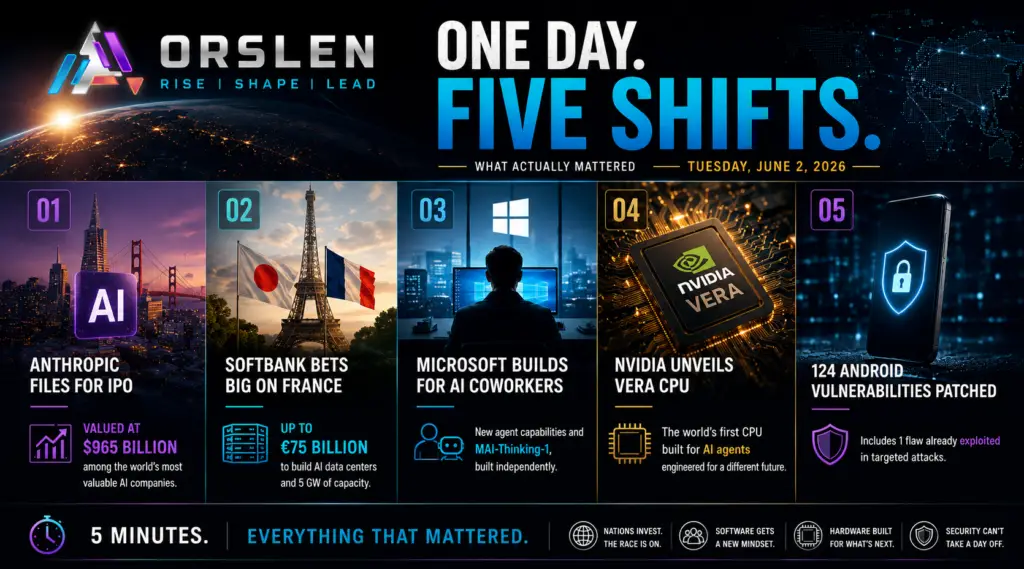
Most days, tech news is a slow drip. June 2 was a flood. In a single Tuesday, a company younger than your old phone lined up to be worth nearly a trillion dollars, Japan dropped the biggest AI cheque Europe has ever seen, and the world’s most valuable chipmaker basically said the next generation of computers won’t be built for humans at all.
We dug through announcements, filings and reporting from three continents so you don’t have to. Here’s what happened — and why it lands on your doorstep too.
Table of Contents
1. A 5-Year-Old Company Is About to Be Worth Nearly a Trillion
San Francisco, USA

Anthropic — the company behind the Claude AI assistant, started back in 2021 — quietly filed the paperwork to sell shares to the public. The price tag attached to it is the eye-watering bit: somewhere around $965 billion. That’s a company barely five years old, knocking on the door of a value it took chip giant Nvidia more than twenty years to reach.
The real drama is the race behind it. By filing first, Anthropic jumped ahead of its better-known rival, OpenAI, in the sprint to Wall Street. Whoever gets there first taps into a giant pool of public money — the cash you need to buy the chips and build the data centers that decide who actually wins the AI race. So this isn’t a victory lap. It’s a dash for fuel before the other guy fills up.
2. Japan Just Bet 75 Billion Euros on France
Paris, France / Tokyo, Japan

Standing next to the French president, the head of Japan’s SoftBank — Masayoshi Son — announced a plan to pour up to €75 billion into AI data centers in France. These are the giant warehouses full of computers that every AI tool quietly runs on. The plan is to build enough of them to power a serious chunk of Europe’s AI ambitions.
Son said the quiet part out loud: the US and China are racing ahead, and “Europe, Japan, Asia have to also go fast, not to be left out.” In other words, this is a continent worried about being a customer in the AI age instead of a player — and a Japanese giant betting big that Europe can still get in the game.
Why care? Because where these data centers get built decides which countries hold the real power in the next decade — and which ones just rent it from someone else.
Read more: Euronews
3. Your Computer Is Being Rebuilt for AI “Coworkers”
San Francisco, USA

At its big yearly event for software builders, Microsoft showed where it thinks everything is heading. Its boss put it simply: AI is moving from a helpful assistant that waits for you, to a “coworker” that goes off and does long tasks on its own. To back that up, Microsoft is rebuilding Windows and Office so these self-directed AI helpers — the ones that click, type and finish jobs for you — become a normal part of how your computer works.
There was a second, sneakier story underneath. Microsoft showed off its own home-grown AI models, including its first big “thinking” model built without any help from OpenAI. Remember, OpenAI is the partner that handed Microsoft its early AI lead. Now Microsoft is building its own engines so it doesn’t have to rent its future from a rival it’s increasingly competing against.
Read more: ChatForest · Tech Times
4. NVIDIA Built a Chip for Robots, Not People
Taipei, Taiwan
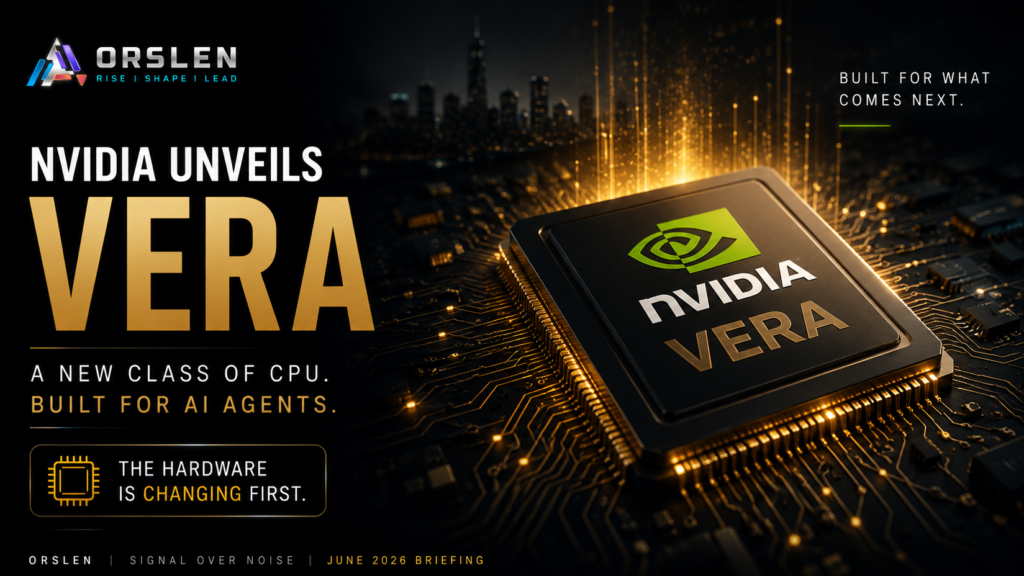
At a big tech show in Taiwan, Nvidia — the company whose chips power almost all of today’s AI — put a brand-new chip called “Vera” into full production. Here’s the striking part: Nvidia openly calls it the first chip built for AI agents rather than human users.
Think about what that means. Until now, AI mostly sat there waiting for you to type a request. The next wave doesn’t wait — it runs tasks, uses tools, checks its own work, thousands of jobs at once, around the clock. That kind of relentless, no-human-in-the-loop work chokes a regular chip, so Nvidia designed silicon just for it, claiming nearly double the speed of the chips we’ve used for decades. Anthropic, OpenAI, Oracle and others are already lining up.
When the hardware itself gets redesigned around a new behavior, that behavior is no longer a maybe. It’s coming.
Read more: NVIDIA Newsroom · HPCwire
5. Check Your Phone — a Hole Was Already Being Attacked
Global

Away from the billion-dollar headlines, here’s the one that touches you directly. Google rolled out its monthly security fix for Android — the system running on most of the world’s phones — and it patched 124 separate weak spots in one go.
One of them matters more than the rest: attackers were already using it in the real world. The nasty detail is that it needed no tap, no download, no mistake on your part to be exploited. That’s the kind of flaw that quietly does damage while you assume everything’s fine.
The fix is boring and free, which is exactly why people ignore it: open Settings, check for a system update, and install it. Two minutes. The flashy AI stories shape the future — but this is the one that protects the phone in your pocket today.
Read more: The Hacker News
The One Thing to Take Away
Money is pouring in (Anthropic). Whole countries are scrambling for a seat at the table (SoftBank and France). Our everyday software and the chips underneath it are being rebuilt for AI that acts on its own (Microsoft and Nvidia). And underneath all the noise, the basics — like updating your phone — matter more than ever.
That’s not five random headlines. It’s one big shift, caught on a single Tuesday, from five corners of the world.
You saw it here first. That’s the whole point of ORSLEN.
— Signal, never noise!