
Five Big Moves That Touch Your Screen and Your Money · 5-min read
Table of Contents
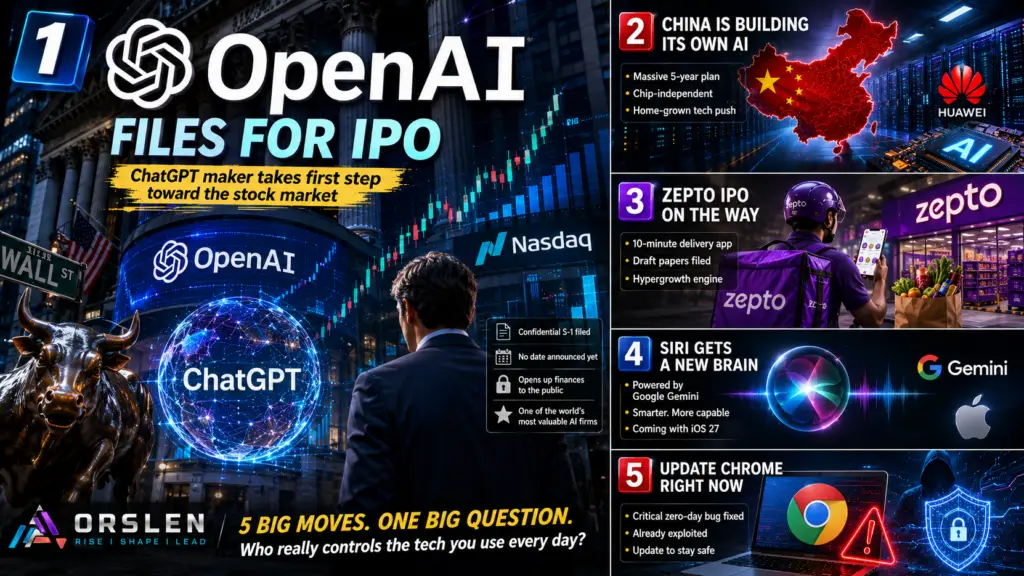
The maker of ChatGPT just took a quiet step toward the stock market. China lined up a giant pile of money to build its own AI. The 10-minute delivery app in your pocket opened its books. Apple gave Siri a new brain — but borrowed it. And your web browser got a warning you should not ignore. One question ties it all together: who really controls the tech you use every day? (We opened every source ourselves first.)
1. OpenAI Just Knocked on the Stock Market’s Door
San Francisco, USA — The company behind ChatGPT wants to sell shares to the public. OpenAI said it has filed a “confidential S-1” (a secret first form you send to the US market regulator before going public). In plain words, this is the first real step toward an IPO (selling shares to ordinary people for the first time).
OpenAI even said it expects the news to leak, so it just announced it itself. It has not fixed a date yet. The company is valued at about $852 billion (roughly Rs 73 lakh crore) — bigger than most companies on earth. Going public also means OpenAI must finally show its real income and losses, which it has kept private till now.
Why this touches you: the AI tools you already use are turning into some of the biggest companies in the world. It joins Anthropic (the makers of Claude) and Elon Musk’s SpaceX, which are also heading to the market. One day, a slice of these could sit inside the same mutual fund or SIP you invest in.
Source: CBS News
2. China Is Quietly Building Its Own AI — No American Chips Allowed
Beijing, China — China is getting ready to spend a huge sum to build its own AI power, and to do it without American chips. The plan is about 2 trillion yuan ($295 billion, roughly Rs 25 lakh crore) over five years, mostly on data centres (big buildings full of computers that run AI).
This was first reported by Bloomberg and then by Reuters. It is still in early talks, so the details could change. State firms China Mobile and China Telecom would run the centres. At least 80% of the tech would be home-made — including Huawei chips — which would push out US chip makers like Nvidia and AMD.
Why this touches you: the world is slowly splitting into two AI camps — one led by the US, one by China. When two giants fight over chips, the whole world’s prices move. That is one big reason the price of your next phone, laptop, or even its memory can rise or fall.
Source: Reuters
3. Your 10-Minute Delivery App Opened Its Books. The Numbers Are Wild.
Bengaluru, India — The app many of us use for 10-minute grocery is about to go public. Zepto filed its updated draft papers (called a DRHP) with SEBI (India’s stock market watchdog). It plans to raise Rs 8,010 crore in fresh shares, with the full IPO size expected to be around Rs 10,000 crore. It would be the first quick-commerce-only company to list in India.
Now the wild part. In FY26, Zepto’s revenue more than doubled to Rs 22,623 crore (from Rs 11,110 crore). But its losses also grew — to Rs 5,905 crore for the year. It handled 210 million orders in the Jan–March quarter alone, and runs 1,139 dark stores (small local warehouses that make fast delivery possible).
Why this touches you: soon you may be able to buy a small piece of the app you order from. But read the fine print — it is growing fast and still burning a lot of cash. For you, it means more deliveries, more ads inside the app, and a real test of whether 10-minute delivery can ever truly make money.
Source: Business Standard
4. Apple Gave Siri a New Brain. It Belongs to Google.
Cupertino, USA — Apple finally gave Siri a real upgrade. At its yearly event for app makers (WWDC), it showed off “Siri AI” — but the brain doing the heavy thinking is Google’s Gemini AI model (Google’s main AI system). For a company that always said it would do AI its own way, paying a rival is a big surprise.
The new Siri can chat back and forth, understand what is on your screen, and finish multi-step tasks across apps. There is a new Siri app, and a “Visual Intelligence” feature (point your camera at something and get answers). It arrives with iOS 27, the next iPhone software.
Why this touches you: a smarter Siri is coming to iPhones. But Apple said it will start in US English, with more languages and regions added later — so Indian users may wait a bit for full support. And a “borrowed brain” raises a fair question: how private are your requests when a rival company helps answer them?
Source: Business Standard
5. Update Your Chrome Right Now — Here’s Why
Mountain View, USA — This is the one story today you can act on in 30 seconds. Google fixed a dangerous bug in Chrome called a “zero-day” (a flaw that hackers were already using before any fix existed). Just opening a bad web page could let an attacker run harmful code on your computer.
The bug is tagged CVE-2026-11645. Google patched it along with 73 other flaws (74 in total). It is the fifth such “already-being-used” Chrome bug this year. The safe version is Chrome 149.0.7827.102 or higher. To update: open the Chrome menu, go to Help, then “About Google Chrome”, and let it relaunch.
Why this touches you: your office laptop, your bank logins, and your saved passwords all sit behind that browser. If you use Edge, Brave, or Opera (which are built on the same base as Chrome), update them too. Do this before you read the rest of your tabs.
Source: The Hacker News
Look at the five together and one word stands out: control. OpenAI and Zepto want a piece of your money through the stock market. China wants control of the chips that power AI. Apple borrowed Google’s brain just to keep you on its phone. And a single browser bug reminds us how much of our daily life sits inside someone else’s software. The tools we use are getting bigger, stronger, and more tangled up with each other. The smart move is simple — stay awake, ask who owns what, and keep your own door (your browser, your data) locked.
ORSLEN – Signal over Noise!