
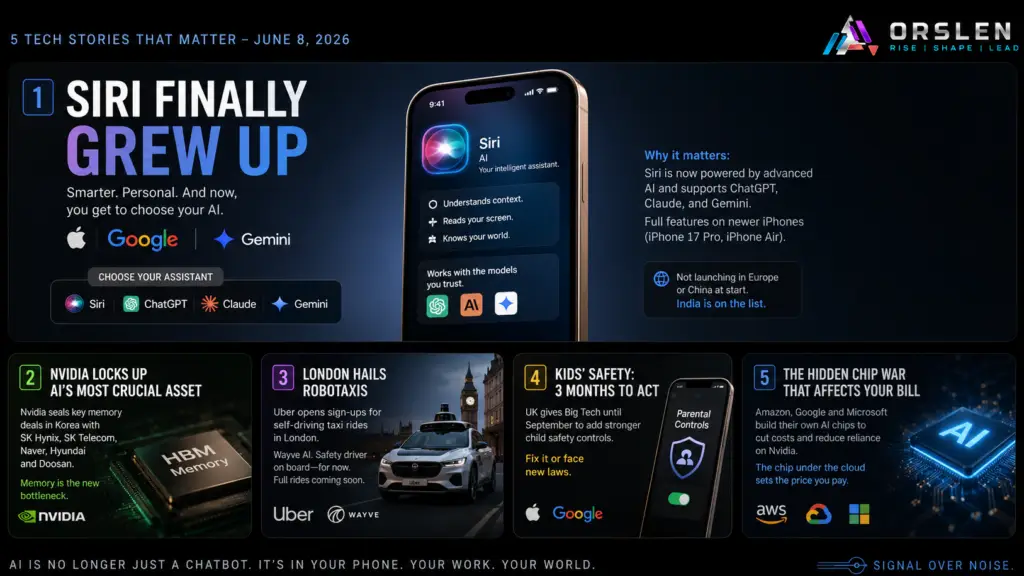
Monday, June 8, 2026 was a loud day in tech. Apple held its big yearly show, Nvidia went shopping in Korea, and London turned into a tech battleground. Here are the five stories that actually matter — explained simply, and tied to your phone, your work and your money.
Table of Contents
1. Siri Finally Grew Up — And Now You Get to Pick Your AI
Cupertino, USA. For years, Siri was the joke of the AI world. On Monday, it finally grew up. At WWDC (Apple’s yearly show for app makers), Apple showed a fully rebuilt “Siri AI.” It can hold a real back-and-forth chat, read what is on your screen, and dig through your own messages, emails and photos to answer you.
The brain behind it is partly Google’s Gemini (Google’s AI model). And here is the twist: Apple is opening up the iPhone so you can choose your assistant — Claude, ChatGPT or Gemini — instead of being stuck with just one.
If you use an iPhone in India, this is coming to you. Apple said Siri AI will not launch in Europe or China at the start — and India is not on that blocked list. The full features will need a newer phone, like the iPhone 17 Pro or the iPhone Air. It was also Tim Cook’s last show as CEO. After a long wait, your phone’s helper may finally be useful.
2. Nvidia Flew to Korea and Locked Up the One Thing AI Can’t Live Without
Seoul, South Korea. The world’s most valuable chip company went shopping in South Korea — and it spent big on the boring part of AI. On June 8, Nvidia (the firm that makes the chips that train AI) announced a wave of deals with Korean giants: SK Hynix, SK Telecom, Naver, Hyundai and Doosan.
CEO Jensen Huang flew in, ate fried chicken with the bosses, and locked in years of supply. The key piece: SK Hynix will keep making the special memory chips (fast storage that feeds the AI brain) that Nvidia’s systems need. SK Telecom will build a giant “AI factory” (a data centre built only for AI) by 2027.
Memory is now the real bottleneck for AI. When memory runs short, the prices of phones, laptops and cloud bills go up — and that reaches your wallet in India too. It also shows the true AI race is about who controls the hardware, not just chatbots. Shares of Samsung and SK Hynix even fell sharply that day on worries the boom may be running too hot, before recovering a little.
Source: Reuters · Korea JoongAng Daily
3. In London, You Can Now Book a Taxi With No Driver
London, UK. Wait — a taxi with nobody driving? Yes. On June 8, during London Tech Week, Uber opened sign-ups for its first robotaxi (a self-driving taxi) rides in the city.
The cars are Ford Mustang Mach-e models, driven by AI from a British company called Wayve. For now, a trained safety person will still sit in the seat, just in case. Full rides should start in the coming months, once UK regulators (the government bodies that approve such things) say yes. It is the first time the public in the UK can hail a self-driving car.
Europe has been slow on robotaxis while the US and China raced ahead, so London joining is a big shift. For India, this is a preview. Our crowded, unpredictable roads are the hardest test on earth, so we are likely years away. But the same “learn by driving” AI from Wayve is the kind that could one day reach Indian cities — and change work for lakhs of drivers.
Source: Reuters · The Next Web
4. Apple and Google Got 3 Months: Fix Kids’ Safety, or Face the Law
London, UK. Also at London Tech Week on June 8, the UK Prime Minister Keir Starmer gave Big Tech a hard deadline. He told firms like Apple and Google they must add controls that stop children from sending or receiving nude images on phones and tablets.
They have until September to act on their own. If they do not, the government will pass a new law to force them. “Tech should adapt to the needs of society, not the other way round,” he said. He also wants AI chatbots brought under the UK’s Online Safety Act (its law to keep people safe online), and is looking at an Australia-style ban on under-16s using risky social media.
Why should you care in India? When a big country sets a rule, phone makers often build the fix once and roll it out everywhere — so a change made for the UK can land on Indian kids’ phones too. India is having the same debate about screen time, age limits and child safety. This is the way the whole world is now moving.
Source: ITV News · Yahoo News
5. The Chip War Nobody Talks About — And It Quietly Sets Your Software Bill
USA. Here is the story almost no one is shouting about, yet it touches your office every day. For years, everyone bought Nvidia chips to run AI. Now the big cloud companies — Amazon, Google and Microsoft — are building their own AI chips to depend less on Nvidia.
Amazon has “Trainium”, Google has “TPU”, and Microsoft has “Maia”. The reason is simple: their own chips are cheaper to run for their own work. Microsoft’s new Maia chips are built to run Microsoft’s own AI tools — like Microsoft 365 Copilot (the AI helper inside Word, Excel and Teams).
You may never see these chips, but you pay for them. The chip under the cloud decides the price of Azure, AWS, and your Microsoft 365 or Copilot plan — the exact tools millions of Indian office workers and IT firms use daily. Cheaper, in-house chips could mean steadier prices and less of one company controlling everything. The AI fight is moving from flashy demos to the plumbing.
Put June 8 together and one idea stands out: AI is leaving the chatbot box and moving into the real world — into your phone’s assistant, the chips in the cloud, the taxi on the street, and the laws that protect your kids. The demos are slowing; the real fight is now over hardware, control and rules. So don’t panic at every headline. Just watch who controls the plumbing — because that is who quietly sets the price and the rules for the rest of us.
ORSLEN – Signal over Noise!