
Five Moves That Touch Your Phone, Your Job and Your Money · 5-min read
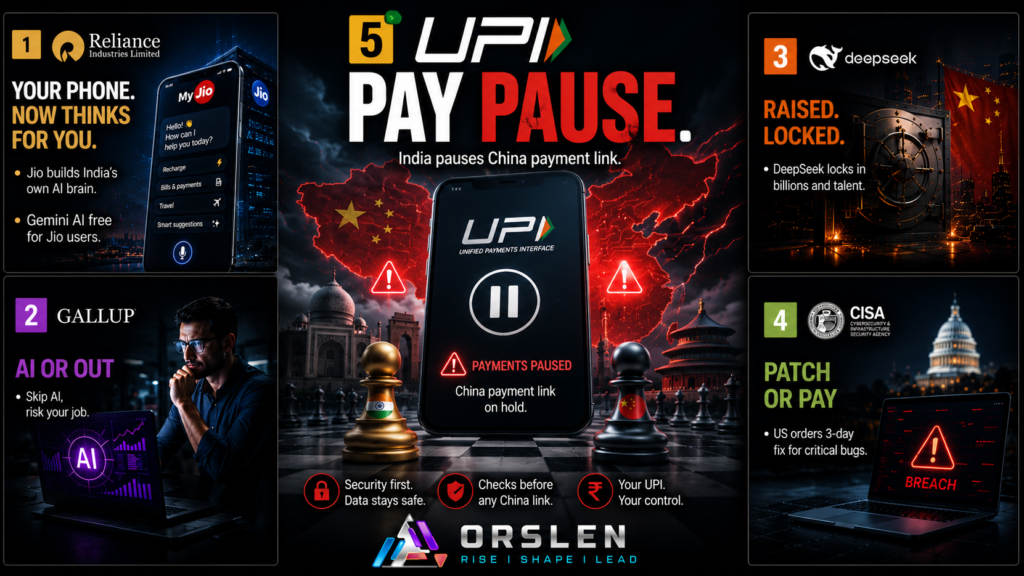
Big day. India’s biggest company says your phone will soon think for you. A fresh study warns that people who skip AI at work could be the first ones fired. China’s hottest AI lab just raised a fortune, then quietly locked its own staff in. Hackers now break in within days, so even the US government is rushing out a new rule. And India hit pause on a China payment link that could have changed how you pay abroad. So who is really pulling the strings in tech today?
(We opened every source ourselves first.)
Table of Contents
1. Your Phone Is About to Become Your Personal AI Advisor
Mumbai, India
Reliance, India’s biggest company, held its yearly meeting (called an AGM) on Friday. Akash Ambani said the MyJio app, used by about 600 million Indians, will become a smart advisor. It will not just sit and wait for you to tap. It will guess what you need and do it for you, but only after you say yes. Now the bigger news. Reliance is building India’s own AI brain in Jamnagar, Gujarat. The first part comes alive by the end of 2026, running on Nvidia’s most powerful chips (the GB300). The idea is simple. India wants to make its own AI, not rent it from America or China. Reliance also said Jio crossed 524 million users, filed papers for its long-awaited share sale (IPO, when a company sells shares to the public) and will give Google’s Gemini AI free to Jio users. For you, that means cheaper, smarter AI on your phone soon. For India, it is a big step to stop leaning on others.
Source: Business Today · Business Today (Jio IPO)
2. Skip AI at Work and You Could Be the First to Go
Washington, USA
Here is a warning that hits close to home. A new study by Gallup (a big survey company) found that tech workers who rarely use AI are three times more likely to lose their jobs. The numbers are blunt. People who use AI tools at least once a month had about a 6 percent chance of being laid off. People who barely touch AI had about 18 percent. The study looked at more than 23,000 US workers. The strange part. Only about 1 in 100 of the people who lost jobs blamed AI directly. Most never saw it coming. The link stayed true even after age, education and job type were taken into account. Why this matters for you, especially in IT. Knowing AI is no longer a nice extra. It is slowly becoming a survival skill. If your work touches a computer, start using AI tools now, not next year. The people who learn it quietly become the ones companies choose to keep.
Source: Business Standard · Bloomberg
3. China’s Top AI Lab Raised a Fortune, Then Locked the Doors
Hangzhou, China
DeepSeek is the Chinese app that shocked the world last year by matching costly US AI for very little money. For years it refused all outside money. Now it has taken its first big funding: about $7.4 billion (about Rs 63,000 crore). But the deal is odd. Investors like Tencent put in money, yet they get no voting power and cannot sell their stake for five years. Only one backer, a Chinese government fund, gets real control. DeepSeek even gave investors a hard rule: do not poach our staff. (Poach means hire away your best people.) Why so strict? China’s AI talent war is brutal, and DeepSeek wants to keep its small, sharp team together. The bigger picture. China is fencing off its best AI from the inside, with the state holding the keys. Many apps you already use may quietly run on DeepSeek in the background, so who controls it is not only China’s problem. It is everyone’s.
Source: CNBC · Tech Times
4. Hackers Now Break In Within Days, So America Made a New Rule
Washington, USA
A bug (a hidden flaw in software) is a hacker’s open door. For years, offices had weeks to fix the worst ones. Not anymore. The US cyber agency, CISA, just ordered all federal offices to fix (patch) the most dangerous flaws in as little as three days. Why the rush? AI. Hackers now use AI to find and attack flaws faster than people ever could. The gap between a flaw being found and being abused has shrunk to almost nothing. One scary number. In 2025 only about 26 percent of the worst known flaws were fully fixed in time, down from 38 percent the year before. The average fix took 43 days. Far too slow. The lesson is the same for you at home. Update your phone and laptop the day the update lands. In an AI world, waiting even a few days can be the gap between safe and hacked.
Source: BleepingComputer · CyberScoop
5. India Hits Pause on a China Payment Link
New Delhi, India
Imagine paying with UPI (your phone payment app) while shopping in China, just like you do at home. That idea is on hold. India was looking at joining UPI with Alipay+, a huge China payment network owned by a firm called Ant. It would have let Indian travellers pay easily at shops linked to that network abroad. But reports say India has quietly paused the plan. The reason is security. Officials want to check how safe Indian payment data would be, and whether the banks are ready, before any China link goes live. No quick decision is coming. Why this touches you. UPI is now India’s pride and runs most of your daily payments. The government is being careful about who it plugs that system into, China most of all. For now, your UPI stays inside trusted borders. It may help travellers one day, but only once India is fully sure it is safe.
Source: Business Today
One thread ties all five together. AI is no longer just a tool you pick up when you feel like it. It is becoming the ground everything stands on. Your phone. Your job. Your money. Even your country’s safety. India is racing to build its own. Workers are racing to learn it. Hackers are racing to abuse it. And governments are racing to decide who holds the keys. The race is on, and none of us are watching from the side. We are all in it.
ORSLEN – Signal over Noise!