
Five Tech Moves That Hit Your Wallet, Your Phone and Your Network · 5-min read
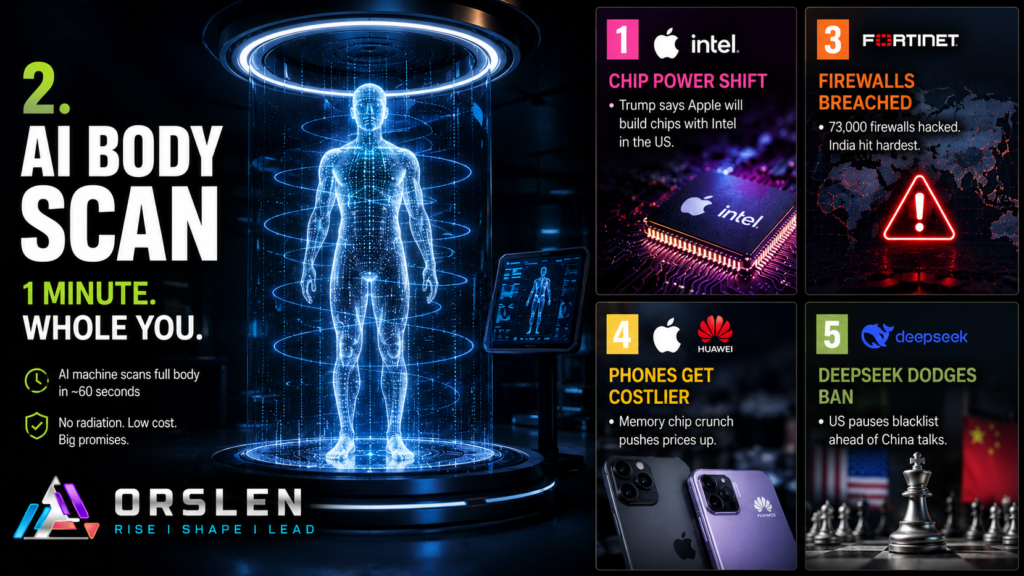
Big day for chips, bodies and passwords. The US President went online and named a deal that could change who builds your iPhone’s brain. An AI art company said it will scan your whole body in one minute. Hackers quietly cracked open tens of thousands of company firewalls, and India is sitting right in the middle of it. Your next phone is about to cost more, and one Chinese AI app just dodged a US ban. So who is really winning the tech race today?
Table of Contents
1. Trump Says Apple Will Build Its Chips With Intel in America
Washington, USA
A chip (the tiny brain inside your phone and laptop) is the heart of every Apple device. For years Apple has made these chips in Taiwan, at a company called TSMC. Now US President Donald Trump says that is changing. In a late night post on his own social site, he said Apple has agreed to design and build its chips with Intel, an old American chip maker, right inside the US.
Intel has been struggling for years. The news sent its share price jumping about 10 percent within minutes. One thing to note: neither Apple nor Intel has officially confirmed the deal yet, so treat the details as Trump’s words for now. Why should you care? Apple boss Tim Cook just warned that iPhone prices will go up, because chips are getting costly. Building more chips at home could ease that pressure over time. But moving chip work to a new factory is slow and hard, so do not expect cheaper iPhones tomorrow.
2. An AI Art App Just Built a Machine to Scan Your Whole Body
San Francisco, USA
Here is the strangest news of the day. Midjourney is famous for one thing. You type words, and it makes a picture. Now the same company says it has built a body scanner. You step onto a platform, it lowers you into a shallow pool of water, and sound waves map your full body. The company claims one scan in about 60 seconds, with no radiation. A normal MRI scan (a big hospital body scan) takes 60 to 90 minutes.
Midjourney wants to open a “spa” in San Francisco by the end of 2027, where anyone can get scanned for just a few dollars (about Rs 300 to Rs 400). Sounds like magic, but stay calm. The real machine today takes about 20 minutes, has been tried on only a dozen people and has no medical approval yet. It built the device with a chip firm called Butterfly Network. Big dream, very early days.
3. Hackers Cracked 73,000 Company Firewalls, and India Was Hit Hardest
Global
A firewall (a guard that protects a company’s network) is supposed to keep hackers out. This week researchers found a huge leak, named FortiBleed, of login details for about 73,000 firewalls made by a company called Fortinet. These guards sit at the front door of offices in 194 countries. The stolen list includes usernames and even plain passwords for big names like Samsung, Oracle, Mercedes-Benz and even Fortinet itself.
The scary part for us at home: security firm SOCRadar says India makes up over 60 percent of the government bodies caught in this leak. Here is the twist. This was not a clever new bug. Hackers simply stole old passwords and used them again, because many companies never bothered to change them. The attack is still going on right now. If your office uses Fortinet, the fix is boring but urgent. Change every password and switch on the extra login step (a second code after the password).
Source: BleepingComputer · BankInfoSecurity
4. Your Next Phone Will Cost More, and Here Is Why
Hong Kong
Phone sales are falling. New numbers from research firm Counterpoint show global phone sales dropped 8 percent in one recent week, the ninth week in a row of falls. Only two brands grew. Apple rose 10 percent and China’s Huawei jumped a big 23 percent. So what is going on?
The villain is memory chips (the part that stores your apps and photos). AI data centres (giant computer warehouses that run AI) are buying these chips in huge amounts. That leaves fewer for phone makers, so prices shoot up. Counterpoint says memory costs have jumped around 40 percent, and average phone prices may rise close to 7 percent this year. The cheap phones under about Rs 17,000, the ones most Indians buy, get hit the hardest. The simple lesson: if you were planning to upgrade your phone, doing it sooner rather than later may save you money.
Source: Counterpoint Research · Sammy Fans
5. US Holds Back From Blacklisting China’s DeepSeek, For Now
Washington, USA
DeepSeek is the Chinese AI app that shocked the world last year by matching costly US apps for very little money. Now Reuters reports that the US had quietly lined up DeepSeek, plus more than 100 other Chinese firms, for a trade blacklist. A blacklist (a banned list) would block American companies from selling to them. The reason given: officials say DeepSeek helped China’s army and spies, and tried to grab banned US chips through fake side companies.
But the White House has hit pause. Why? President Trump has a big visit to China coming up, and a blacklist right now could blow up trade talks. So politics won, at least for today. This matters because many companies, even in the US, use DeepSeek as a cheaper AI option. The fight between the US and China over who controls AI is far from over, and the apps you use sit right in the middle of it.
Source: CNBC · Tom’s Hardware
One thread runs through all five. From Apple’s chips to your phone’s memory to China’s AI, the whole tech world is fighting over the same thing: who controls the tiny pieces that power everything. And while the giants fight, the cost and the risk quietly land on us, the users. Watch the chips. They quietly decide the prices, the power and the politics.
ORSLEN – Signal over Noise!