Even Google Ran Out of AI Power · 5-min read
Tuesday, June 30, 2026
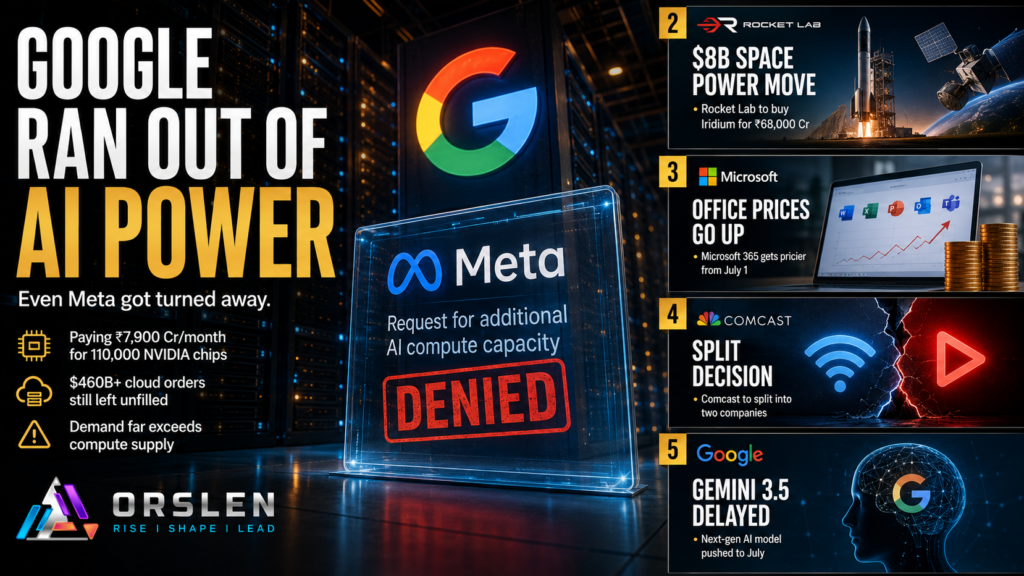
Google is so short of computer power that it said no to Meta. A rocket company just bought a satellite giant. Your office software gets pricier from tomorrow. A cable giant is splitting itself in two. And Google’s own next big AI just turned up late. What is pushing all of them at once? (We opened every source ourselves first.)
Table of Contents
1. Google Told Meta No. It Ran Out of AI Power.
Mountain View, United States
Google is one of the biggest tech firms on earth. It still could not give Meta (the owner of Facebook, Instagram and WhatsApp) all the computer power Meta wanted. Around March, Google quietly capped how much Meta could use its Gemini AI models (the smart software behind Google’s chatbot). Meta had leaned on Gemini for big jobs like catching scams and pulling down harmful posts. Now Meta has told its own staff to go easy on “tokens” (the units that measure AI use, a bit like minutes on a recharge). It is also shifting work to its own new model called Muse Spark.
Here is the wild part. Google itself is so short of power that it agreed to pay Elon Musk’s SpaceX about 920 million dollars a month (around Rs 7,900 crore) to rent roughly 110,000 Nvidia chips. Google called this “bridge” help just to keep up. Its pile of unfilled cloud orders has crossed 460 billion dollars (about Rs 39 lakh crore). Why it matters to you: the whole world wants AI faster than anyone can build the machines to run it. That is why your AI apps stall at times and why prices keep climbing.
Source: CNBC · AI Magazine
2. A Rocket Maker Just Bought a Satellite Giant for Rs 68,000 Crore
Long Beach, United States
Rocket Lab builds rockets that carry things to space. On Monday it agreed to buy Iridium, a company that runs a network of satellites circling the earth. The price is about 8 billion dollars (around Rs 68,000 crore). Iridium’s satellites send calls, messages and location data to places normal phone towers cannot reach, like ships at sea, aeroplanes and far-off villages.
So why buy it? Until now Rocket Lab mostly launched other people’s satellites for a fee. With Iridium it will build, launch and run its own. That turns it into a real rival to Elon Musk’s SpaceX in the space business. The deal should close around the middle of 2027, once shareholders and regulators say yes. Why it matters to you: space is quietly becoming normal phone and internet service. Soon your own phone may link straight to a satellite when there is no signal. Deals like this decide who controls that future and what it costs you.
Source: Rocket Lab · Aerospace Global News
3. From Tomorrow, Microsoft Office Costs More
Redmond, United States
If your office runs on Microsoft 365 (the paid bundle of Word, Excel, Outlook, Teams and cloud storage), the bill is going up. The new prices start on July 1, which is tomorrow. The common business plan called Microsoft 365 E3 rises from 36 dollars to 39 dollars per user each month (about Rs 3,080 to Rs 3,335). The fancier E5 plan goes from 57 to 60 dollars (about Rs 4,875 to Rs 5,130). Cheaper plans like Business Basic and Business Standard go up too, and some frontline worker plans jump a lot more.
One bit of relief. If you already pay for it, your price stays the same until your plan comes up for renewal. New buyers and anyone renewing after July 1 pay the new rate. Microsoft says it is adding extra security and AI features to soften the hit. Why it matters to you: most Indian offices, big and small, run on this software. A few dollars per person each month sounds tiny. Across a 100-person company it quietly turns into real money every year.
Source: Microsoft · Directions on Microsoft
4. A US Cable Giant Is Breaking Itself in Two
Philadelphia, United States
Comcast is one of America’s biggest companies. On Monday it said it will split into two separate companies. One half keeps the internet and mobile business that reaches 65 million homes. The other half takes the TV and film business, including NBC, the Peacock app, Sky in Europe and the Universal theme parks. It is a clean break, done in a tax-free way, and should finish in about a year.
Why break up a giant? People are dropping old cable TV and watching online instead. By cutting the two apart, each side can chase its own path without dragging the other down. Investors liked the plan and Comcast’s share price rose on the news. Why it matters to you: this is the clearest sign yet that the old TV business is fading and fast internet is the real prize. The same shift is happening in India, where your phone data plan, not a cable box, now feeds your screen.
5. Google’s Next Big AI Is Running Late
Mountain View, United States
Google had promised its newest top AI model, called Gemini 3.5 Pro, would land in June. It is now late and pushed to July. Google says it needs more time to test the model and fix rough edges, mainly for harder jobs like writing code and running “agents” (AI that does many steps on its own). A smaller, faster version called Flash is already out. But some users said it burned through tokens (the AI usage units) too fast, which pushes up costs.
The timing stings. Rivals OpenAI (the maker of ChatGPT) and Anthropic (the maker of Claude) are racing for the same business customers, and a few weeks can decide who wins a deal. Some senior Google AI staff have also left for those very rivals. Why it matters to you: the AI you use at work and on your phone is being shaped by this race right now. When a giant like Google has to slow down, it tells you these tools are far harder to get right than the hype suggests.
Source: Investing.com · Analytics Insight
Look at all five together and one thread ties them. Everyone wants AI, and nobody has enough of what it needs. Google cannot find enough computer power. Microsoft is charging more for it. Rocket Lab is buying its way into space to carry it. Comcast is splitting up to chase the internet that feeds it. And even Google’s own new model is running late. The race is no longer about clever apps. It is about who controls the chips, the power, the satellites and the wires underneath. That fight will shape your bills, your job and your phone for years to come.
ORSLEN – Signal over Noise!