
Updated June 2026
Microsoft is raising prices on most Microsoft 365 commercial plans starting July 1 2026. If you are about to buy, renew or upgrade, the plan you pick this year locks in your cost and your security posture for the term ahead. This guide answers two questions in order. First, Office 365 or Microsoft 365, which family do you even need. Second, which exact plan to buy in 2026 once the new prices land. There is a short answer for busy readers and a full breakdown for anyone who wants to get it right.
Table of Contents
The 60 Second Answer (TL;DR)
- Most small businesses do not choose Office 365 vs Microsoft 365 anymore. Under 300 users, every plan is branded Microsoft 365 Business. The real Office 365 vs Microsoft 365 fork only exists at enterprise scale.
- Need only email and web apps: Business Basic.
- Need installed desktop Office apps: Business Standard.
- Anyone touching sensitive client, financial or board data, or any team that wants device control and real threat protection: Business Premium.
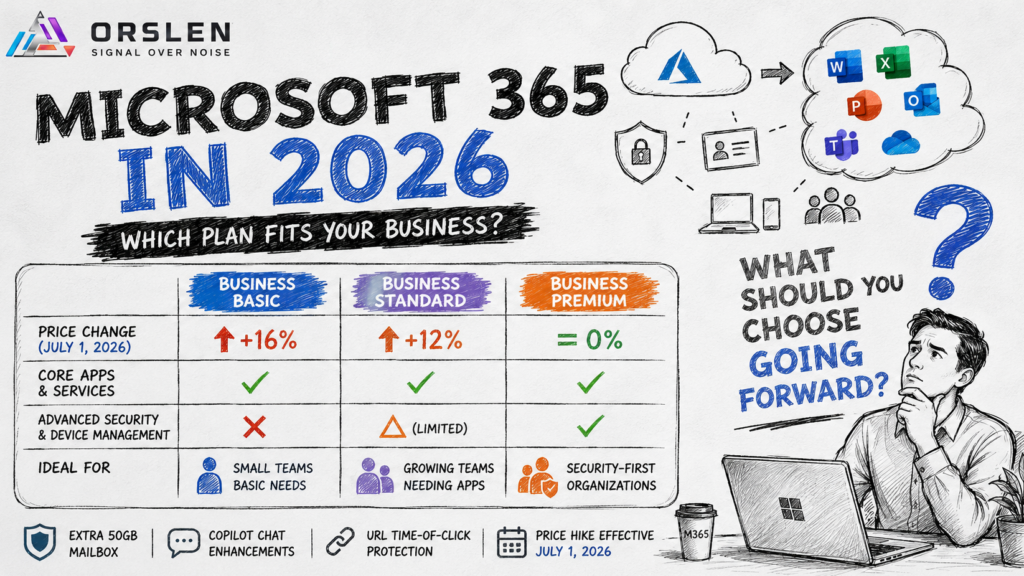
- The July 1 twist: Basic and Standard get more expensive, Premium price stays flat, and all three gain features. That makes Premium the relative value winner in 2026. If you were on the fence between Standard and Premium, the gap just shrank.
- If your renewal lands in June 2026, renewing before July 1 locks in current pricing for your full term. Right-size first, then lock.
Step 1: Office 365 or Microsoft 365? Know the Difference First
People use these two names as if they mean the same thing. They do not. Getting this right is the difference between paying for protection you need and paying for licences you will never use.
- Office 365 is the productivity layer. Email (Exchange Online), file storage (OneDrive and SharePoint), Teams and the Office apps (Word, Excel, PowerPoint, Outlook). That is the whole story. No Windows operating system licensing, no advanced identity, device or threat management.
- Microsoft 365 is a superset. It is everything in Office 365, plus Windows Enterprise licensing, plus the Enterprise Mobility and Security stack (Microsoft Entra ID identity, Intune device management and Microsoft Defender threat protection). It is built to run and secure a whole organisation, not just to give people apps.
| What you get | Office 365 | Microsoft 365 |
|---|---|---|
| Office apps (Word, Excel, PowerPoint, Outlook) | Yes | Yes |
| Email, OneDrive, SharePoint, Teams | Yes | Yes |
| Basic email protection (Exchange Online Protection) | Yes | Yes |
| Windows Enterprise OS licensing | No | Yes |
| Microsoft Entra ID advanced identity (P1 or P2) | No | Yes |
| Intune device management | No | Yes |
| Microsoft Defender advanced threat protection | No | Yes |
| Best described as | Apps and services | A managed, secured workplace |
The part nobody explains: for any business under 300 users, the old Office 365 Business plans were renamed Microsoft 365 Business back in April 2020. So when you shop for a small business plan today you are choosing between Microsoft 365 Business Basic, Standard and Premium. The genuine Office 365 versus Microsoft 365 decision (for example Office 365 E3 versus Microsoft 365 E3) only shows up at enterprise scale, 300 users and above. Even so the philosophy carries down. Business Basic and Standard follow the Office 365 idea of apps and services. Business Premium follows the Microsoft 365 idea by adding the full security and device management stack.
Step 2: What Actually Changes on July 1 2026
Effective July 1 2026
Microsoft announced this update on December 4 2025. New and renewing customers pay the new prices from July 1 2026. Existing customers keep their current price until their first renewal on or after that date. The figures below are Microsoft official list prices, per user per month, annual commitment, in USD, for the Teams-included plans. India and other regions are billed locally and at lower, purchasing-power-adjusted rates, so treat the rupee column as a rough conversion of the USD list and not as the India list price. More on India pricing further down.
Business plans (most small and mid businesses)
| Plan | Old USD | New USD | Change | Approx INR (conversion of USD list) |
|---|---|---|---|---|
| Business Basic | $6.00 | $7.00 | +16% | ~₹600 |
| Business Standard | $12.50 | $14.00 | +12% | ~₹1,200 |
| Business Premium | $22.00 | $22.00 | No change | ~₹1,890 |
Enterprise plans (300+ users)
| Plan | Old USD | New USD | Change |
|---|---|---|---|
| Office 365 E1 | $10.00 | $10.00 | No change |
| Office 365 E3 | $23.00 | $26.00 | +13% |
| Office 365 E5 | $38.00 | $41.00 | +8% |
| Microsoft 365 E3 | $36.00 | $39.00 | +8% |
| Microsoft 365 E5 | $57.00 | $60.00 | +5% |
What is NOT changing
- Business Premium list price stays at $22.
- Consumer plans (Personal, Family) and education pricing are untouched by this update.
- Standalone Microsoft Teams and standalone Microsoft 365 Copilot add-on pricing are unchanged.
- Microsoft 365 E7 pricing is not changing.
You also get more for the money
Microsoft frames this as a value expansion, not just a hike, and there is real substance to it. Rolling out by August 1 2026, all three Business plans add 50GB of extra mailbox storage and Copilot Chat enhancements (inbox and calendar awareness, plus Word, Excel and PowerPoint agents). Business Basic and Standard additionally gain URL time-of-click protection, a feature that checks links at the moment a user clicks rather than only at delivery. That used to sit behind the premium security tiers. Moving it down closes a real phishing gap for smaller teams.
Step 3: The Real Takeaway Most Articles Miss
Look at the Business table again. Basic rises 16 percent, Standard rises 12 percent, and Premium does not move. At the same time Premium keeps its big advantages, Microsoft Defender for Business, Intune device management and Entra ID Plan 1 identity, which Basic and Standard still do not have.
The practical result: the price gap between Standard and Premium narrows in 2026, while the security gap stays wide. If you were undecided between Standard and Premium, the maths now tilts toward Premium for any user who handles customer data, finances, identity documents or anything you would not want leaked. You are paying a smaller premium for a far stronger security and management posture. For a regulated or data-sensitive team, Premium is the plan that ages well.
Step 4: Which Plan Should You Buy in 2026
Business Basic, buy this if
- Your team mostly needs professional email on your own domain, Teams, and the web and mobile versions of Office.
- Think shift workers, shop-floor staff, field teams and anyone who lives in a browser.
- You do not need installed desktop Office apps and you do not need device management.
Business Standard, buy this if
- People need the full installed desktop apps on their laptops, offline and feature complete.
- This is the default for most office knowledge workers on a personal or company laptop.
- You are comfortable with standard security and do not yet need centralised device control.
Business Premium, buy this if
- Any user touches sensitive data: client records, financials, PAN or Aadhaar or GSTIN data, contracts or board material.
- You want to manage and secure devices (Intune), enforce conditional access and MFA properly (Entra ID P1) and get real threat protection (Defender for Business).
- You operate in a regulated space or simply take a breach seriously. After July 1 2026 this is the strongest value tier for serious teams.
Enterprise (E3 or E5, Office 365 or Microsoft 365), buy this if
- You are over 300 users, or you need enterprise grade compliance, analytics and identity.
- Choose Office 365 E-plans if you only need productivity and email at scale. Choose Microsoft 365 E-plans if you also need Windows licensing and the full security and device stack.
- Go E5 over E3 when you would otherwise buy Defender, Entra ID P2 and Purview compliance as separate add-ons. At that point E5 often works out cheaper than assembling the parts.
Pro move: mix plans by role
You do not have to put everyone on the same plan. Microsoft lets you assign different plans to different users in one tenant. Put warehouse and shift staff on Basic, office staff on Standard and anyone handling sensitive data on Premium. Paying for Premium across a whole company when only a third of users need the security is one of the most common and expensive mistakes. Map plan to job function, not to convenience.
A Note for Indian Businesses
Microsoft 365 in India is billed in rupees through Microsoft India or a Cloud Solution Provider, and India list prices are set well below the USD list under purchasing-power pricing. As a rough orientation Business Basic has commonly sat near a few hundred rupees per user per month before tax, with Standard and Premium scaling up from there, but published reseller numbers vary and 18 percent GST applies on top. Microsoft has said the July 1 2026 increase applies globally with local market adjustments, so Indian rupee list prices may also move. Confirm the exact current India figure on Microsoft India pricing or with your CSP before you commit. Two India-specific points worth money:
- GST input credit: if you buy through a CSP with GST-compliant INR invoices, the 18 percent GST is claimable as input tax credit for a registered business. That materially lowers your effective cost.
- Rupee depreciation: because list pricing tracks the dollar over time, a weakening rupee can raise your renewal even if Microsoft does not change the base price. An annual or multi-year commitment locks your rate for the term and protects you from that drift.
Before You Buy or Renew: A Short Checklist
- Check your renewal date. If it lands in June 2026, renewing before July 1 locks current pricing for the full term. A June renewal that completes on July 3 is a July renewal, so do not let it slip.
- Right-size before you lock. Pull the 90 day sign-in activity report in the Microsoft 365 admin center. Cut licences for leavers, dormant accounts and service accounts sitting on full suites. Cut first, then commit.
- Re-run the Standard versus Premium maths with July pricing. The narrowed gap may now justify Premium for your data-sensitive users.
- Map plans to roles. Mix Basic, Standard and Premium by job function instead of overpaying across the board.
- India: buy through a GST-registered CSP so you can claim the input credit and get predictable INR billing.
Bottom Line
For most businesses in 2026 the choice is not Office 365 versus Microsoft 365, it is which Microsoft 365 Business tier fits each person. Basic for email and web, Standard for desktop apps, Premium for anyone near sensitive data. The July 1 price increase makes Premium the standout value because its price held while Basic and Standard rose and every plan gained features. Decide by role, right-size before you lock and if your renewal is close, move before July 1 to hold today’s pricing.
Sources
- Microsoft Licensing: Microsoft 365 Pricing and Packaging Updates (official price tables)
- Microsoft 365 Blog: Advancing Microsoft 365, new capabilities and pricing update
- Microsoft Licensing: 2026 Pricing and Packaging Updates FAQ
- Microsoft India: Compare Microsoft 365 plans and pricing
- Microsoft Learn: Office 365 versus Microsoft 365 distinction (MS-900 study guide)