
China’s Chip-Free AI, Your Costlier Phone and Amazon in Court · 5-min read
Wednesday, July 1, 2026
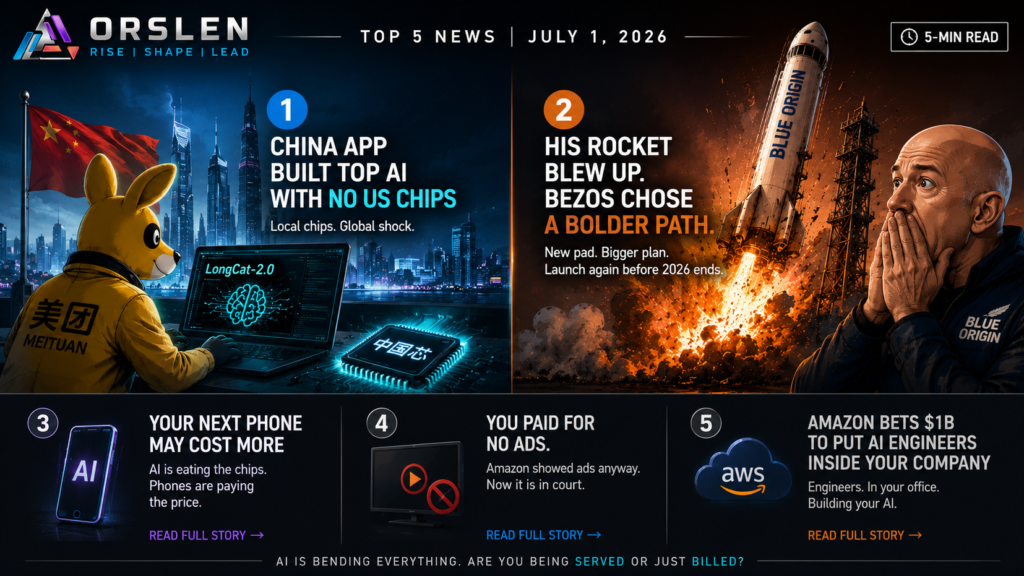
A food-delivery app in China just built a top AI brain using zero American chips. Your favourite phone brands are quietly making fewer phones this year and the reason is not what you think. Down in Australia, Amazon has been dragged to court over a sneaky Prime bill. And a billion dollars plus a blown-up rocket are both chasing the very same prize. What is really pulling all five strings on the same day?
(We opened every source ourselves first.)
Table of Contents
1. A Food-Delivery Giant Built a Top AI With No American Chips
Beijing, China
Wait, what? A company famous for delivering dinner just made one of the world’s most powerful AI models. And it did it without a single top American chip.
Meituan (China’s biggest food and local services app, think of it like a giant Swiggy plus Zomato) released LongCat-2.0 on Tuesday. It is a huge free AI model (a computer brain that reads and writes software code). It has 1.6 trillion parameters (the tiny knobs a model learns from, more knobs usually means a smarter model). On one hard coding test it scored higher than OpenAI’s GPT-5.5. Best of all, it is free to download and change by anyone.
Here is the shock. Meituan says it trained the whole thing on 50,000 chips made inside China, using no Nvidia (the US chip king whose best chips China is banned from buying). Washington blocked those chips to slow China down. China just showed it can reach the top anyway with its own silicon. For coders everywhere, including in India, a free and strong AI like this means cheaper tools and less need to pay foreign firms.
Source: VentureBeat · SiliconANGLE
2. Your Next Phone May Cost More, and AI Is the Reason
Taipei, Taiwan
Xiaomi, Oppo and Vivo are three of the biggest phone brands in India. This year they plan to make far fewer phones. And the strange villain behind it is AI.
These Chinese makers have told their parts suppliers they will cut how many phones they build in 2026, some by as much as 30%. Xiaomi has pulled its plan down to about 95 million phones, from 135 million earlier and 170 million last year. Oppo and Vivo have each dropped below 90 million, going by a report from Nikkei Asia.
Why is this happening? Memory chips (the parts that store data inside your phone) are being grabbed by AI data centres instead. One big Nvidia AI unit eats up the memory that would have gone into many phones. So phone makers cannot get enough parts and the parts they do get cost more. Experts now think the world phone market may shrink by 14% this year, the biggest fall ever recorded. For you that means higher prices, fewer models and longer waits, so it may be worth holding on to your current phone a little longer.
Source: Nikkei Asia · Digit
3. You Paid for No Ads. Amazon Showed Ads Anyway. Now It Is in Court
Canberra, Australia
Picture this. You pay a full year up front for an ad-free service. Months later the ads show up. And to remove them, you must pay extra. Australia says that is exactly what Amazon did.
Australia’s consumer watchdog (the ACCC, a government body that guards shoppers) has taken Amazon to the Federal Court. It says more than one million people paid about 79 Australian dollars (around 54 US dollars, roughly Rs 4,600) for a year of Prime, when Prime Video was ad-free. Then in 2024 Amazon added ads. To stay ad-free, members had to pay an extra 2.99 dollars a month (about Rs 175). No refund was offered.
The watchdog also claims Amazon’s head office in the US knew about the plan and helped roll it out. It wants fines plus money back for users. Why should you care, sitting in India? Because this is the quiet trick many apps use: change the deal after you have already paid. If Australia wins, streaming and subscription apps around the world may be forced to ask you first before they make a service worse.
Source: Capital Brief · The Conversation
4. Amazon Bets a Billion Dollars to Put Its AI Engineers Inside Your Company
Seattle, United States
Amazon’s cloud arm just made a bold move. Instead of only handing you AI tools, it will send its own engineers to sit inside your office and build the AI for you.
AWS (Amazon Web Services, the rented servers that quietly run a huge part of the internet) is spending 1 billion dollars (about Rs 8,550 crore) on a new team. Small groups of five or six AI engineers will move into a customer company for around 45 days. There they will build agentic AI (AI that can do full tasks on its own, not just chat) straight into that firm’s daily work. AWS plans thousands of these engineers. Early clients include the NFL, the NBA and Southwest Airlines.
It is the first big cloud company to do this in such an open way. Here is why it matters for India. Our top IT firms like TCS, Infosys and Wipro make their money doing exactly this kind of hands-on tech help for global clients. If a cloud giant now does it in-house, that is a direct hit to a business millions of Indian jobs depend on.
5. His Rocket Blew Up. Bezos Just Made a Bold Call on What Comes Next
Cape Canaveral, United States
A month ago a giant rocket exploded on the ground and wrecked its launch pad. Now the company behind it has decided something surprising: do not rebuild the old pad, build a better one, and do it fast.
Blue Origin (the space company owned by Amazon founder Jeff Bezos, a rival to Elon Musk’s SpaceX) saw its huge New Glenn rocket blow up during a ground test on May 28. That wrecked its only working launch pad. On Tuesday the boss, Dave Limp, said they will not rebuild the same pad. Instead they will switch to a new hybrid pad design they were already planning for a bigger rocket. They still hope to fly again before the end of 2026, a target many experts call very hard.
Early clues point to the rear part of the rocket’s first stage as the cause. Why does a US rocket matter to you? Because space is now a race to control internet beamed from the sky (like Starlink) and future moon trips. Every Blue Origin stumble hands more of that future to SpaceX. And satellite internet is one of the real ways far corners of India may finally get online.
One thread ties this whole day together: the AI boom is now bending everything around it. It is pushing China to build its own chips and its own top models. It is pulling the memory out of your next phone. It is drawing a billion dollars into teams that will build AI right inside other firms. Even the fights, from Amazon’s ads to Bezos’s rockets, are really about one thing: who controls the tools, the screens and the sky above us. So the real question for you is simple. As this race speeds up, are you being served by it, or just billed by it?
ORSLEN – Signal over Noise!