
India vs WhatsApp, the Death of Game Discs and the Great AI Layoff U-Turn · 5-min read
Thursday, July 2, 2026
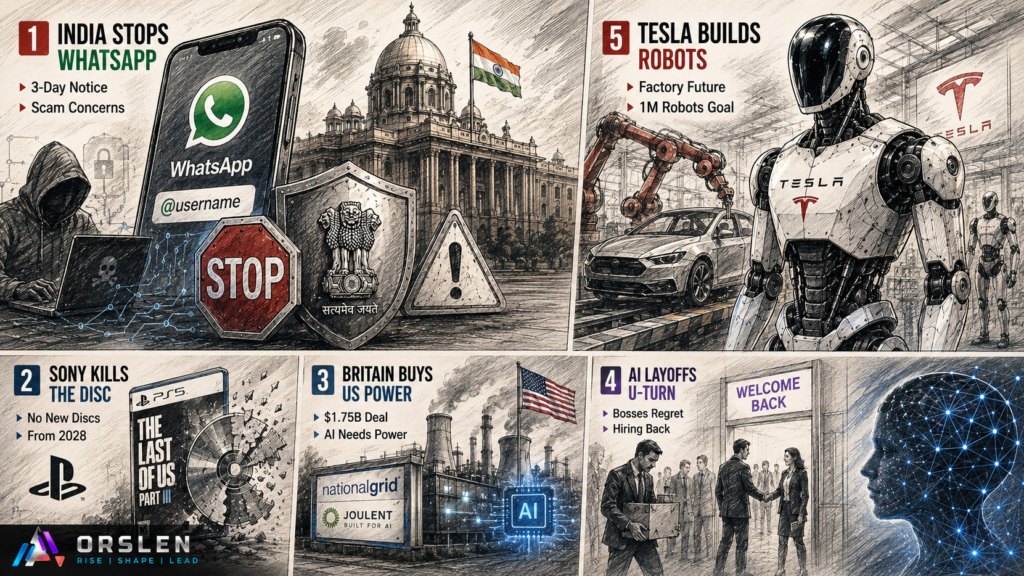
India just told the world’s biggest chat app to stop and gave it only three days to explain. Sony is killing the game disc for good. Britain is quietly buying into American power plants and the reason is AI. Bosses who fired staff for AI are now sheepishly asking them back. And one famous Tesla car line is now building robots. One single force ties all five together. Can you spot it?
(We opened every source ourselves first.)
Table of Contents
1. India Told WhatsApp to Stop, and Gave It Just Three Days
New Delhi, India
India just did something rare. It told WhatsApp, the app almost every Indian uses, to hit pause. And it gave the company only three days to explain itself.
WhatsApp wants to add usernames (a name tag like @rahul so people can message you without seeing your phone number). Sounds good for privacy. But India’s tech ministry (MeitY, the government body that makes IT rules) sent Meta, WhatsApp’s owner, a formal notice on Wednesday. It ordered Meta not to launch usernames in India until the government is satisfied, and to explain within three days.
The worry is fraud. A crook could pick a username that looks like your bank or a government office and fool you. The notice said the feature “may materially increase online fraud, phishing, digital arrest scams and impersonation.” Here is why this matters to you. India is WhatsApp’s biggest market with more than 500 million users. That is you, your parents, your office group. If a scammer can message you pretending to be “SBI Support” without any number showing, the danger is real. This fight will also shape how WhatsApp builds the feature for the whole world.
Source: India TV News · YourStory
2. Sony Is Killing the Game Disc for Good
Tokyo, Japan
If you love buying a game in a shiny box off a shop shelf, here is some sad news. Sony is ending the game disc.
On Wednesday Sony (the Japanese company behind PlayStation) said that from January 2028 it will stop making physical discs for all new PlayStation games. After that date new games will sell only in digital form, either on the online PlayStation Store or as a code you buy in a shop. Games already out on disc before 2028 are safe. Sony says it is just following its buyers. Nearly 4 out of 5 PlayStation games are already bought as downloads, not discs.
This is the slow death of truly “owning” a game you can hold, lend to a friend or sell later. Once a game is only digital, you are really renting access from a store that could shut one day. It also hints that the next PlayStation may not even have a disc slot. And there is a money angle. Memory chip prices are rising because of AI, so consoles are already getting costlier. The PS5 disc model was pushed up this year to about 650 dollars (around Rs 55,000) in the US. For Indian gamers who often buy and resell discs to save money, going all digital quietly takes that option away.
Source: PlayStation Blog · CNBC
3. A British Firm Is Buying US Power Plants, Because AI Is That Hungry
London, United Kingdom
Here is a strange sign of the times. A British power company just put 1.75 billion dollars into building electricity plants in America. The reason? AI.
National Grid (the company that runs much of Britain’s power network) is buying a 35% share of Joulent, a US firm that builds power for data centres (the big buildings full of computers that run AI and the internet). The deal is worth 1.75 billion dollars (about Rs 15,000 crore). Their first project is a large gas power plant in Texas that will feed a Microsoft data centre for 20 years.
AI does not just need chips. It needs huge amounts of electricity. Power demand from AI data centres jumped 17% last year, while normal power use grew just 3%. So the real race now is for electricity, not only chips. When the world’s power gets pulled toward AI, it can push energy bills up and strain grids everywhere. In India, where many of us already face power cuts in peak summer, that is not a far away problem. It is a reminder that the AI boom runs on the same wires that run your home.
Source: PR Newswire · Seeking Alpha
4. Bosses Fired Them for AI. Now They Are Begging Them Back
New York, United States
Remember all those companies that fired people and said “AI will do the job now”? Many are quietly calling those same people back.
A fresh report shows a clear U-turn. Bosses who cut staff and blamed AI are now rehiring, because the AI could not fully do the work. Carmaker Ford is bringing back hundreds of experienced engineers to fix quality problems the machines missed. Tech giant IBM used AI for HR (staff support work) and it handled about 94% of routine requests, but it could not manage the tricky 6% that needed human judgment. IBM is now tripling its fresh graduate hiring in the US. One big survey found 55% of employers regret their AI layoffs.
This is huge for anyone who works, especially for India’s giant IT crowd. It calms the scary story that AI will simply replace everyone. The truth is quieter. AI is great at boring, repeat tasks, but it still needs people for judgment, trust and messy real world problems. So the smart move is not to panic about AI taking your job. It is to learn to use AI well, so you become the person a company cannot afford to lose.
5. Tesla’s Famous Car Line Now Builds Robots That Walk
Fremont, United States
Tesla just did something wild. The same factory line that built its famous Model S car is now building robots that walk like humans.
On Tuesday Elon Musk posted a photo of himself on the new robot line at Tesla’s Fremont factory in California. Tesla stopped making its old Model S and Model X cars this year and rebuilt that line to make Optimus (a human shaped robot meant to do factory work and, one day, chores at home). Musk wants to eventually build up to 1 million robots a year there.
Right now each robot is costly to make and Musk admits the early numbers will be slow. Still, this is a real bet that robots, not cars, are Tesla’s future. If it works, human shaped robots could start doing warehouse and factory jobs within a few years. Tesla is not alone. Firms in the US and China are racing hard too. The dream price one day is about Rs 17 lakh to Rs 25 lakh per robot, cheaper than many cars. If that ever comes true, it could slowly change what “work” means for millions of people, including here in India.
Look closely and the same thread runs through all five. Powerful tech is pushing hard into our lives and the world is pushing back to stay in control. India wants control over your identity. Sony takes control over how you own your games. Britain is chasing control over the power that feeds AI. Workers are winning back control from machines that overpromised. And Tesla is betting robots will soon run the factory floor. The tools are getting stronger by the day. So the real question is simple. Who stays in charge, them or you?
ORSLEN – Signal over Noise!