
Google’s Big EU Defeat, the US Eyeing a Slice of ChatGPT and a New Sea Cable to India · 5-min read
Friday, July 3, 2026
Europe just handed Google its biggest court defeat and there is no way back this time. In America the government may soon own a piece of the company behind ChatGPT. Gulf oil money is quietly buying into cheap AI. A giant new cable is heading under the sea to India. And China’s Alibaba just paid a heavy price in the US. One force is pulling all these strings. Can you name it?
(We opened every source ourselves first.)
Table of Contents
1. Google Lost Its Biggest EU Fight, and This Time There Is No Way Back
Brussels, Belgium
Your phone almost surely runs Android. Today Europe said Google broke the rules to keep it that way, and Google has run out of ways to fight back.
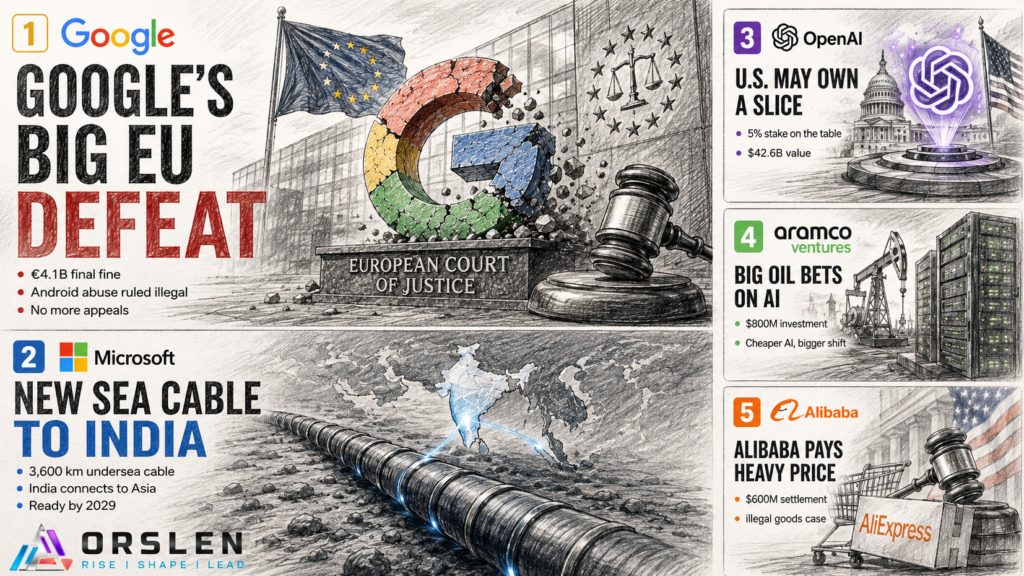
The European Union’s top court (the Court of Justice, the highest court in the EU) said Google must pay a fine of about 4.1 billion euros (around 4.67 billion dollars, roughly Rs 40,000 crore). This is the final word. Google cannot appeal again. The case goes back to 2018. The EU found that Google used Android (the phone software that runs about 80% of the world’s smartphones) to crush rivals. It made phone makers pre-install Google Search, the Chrome browser and the Play Store if they wanted Google’s apps at all. That quietly locked Google Search in as the default and left rivals no fair chance.
Why should you care? Because this is the phone in your pocket. It is the reason Google apps come loaded on nearly every Android phone in India. The ruling is a big win for regulators and will push them across the world to chase Google harder. Over the last decade Google has already piled up close to 11 billion euros in EU fines. More cases are lining up.
2. A Giant New Internet Cable Is Heading Under the Sea to India
Machilipatnam, India
Here is something most of us never think about. The internet does not float in the sky. It runs through cables under the sea. And a big new one is coming straight to India.
A group led by Microsoft and a Singapore firm called Lightstorm is building a new undersea cable (a thick wire laid on the ocean floor that carries internet data). It is named I-2SEA. It will run 3,600 km and link India directly to Malaysia and Singapore. Other partners include Tata Communications, Singtel and Japan’s NEC. The cable will land on India’s east coast at Machilipatnam in Andhra Pradesh, with a direct path to the data centres near Hyderabad. It should be ready by the end of 2029.
Undersea cables carry about 95% of the world’s internet traffic. AI needs to move huge amounts of data very fast, so more cables mean quicker, steadier internet for AI and cloud services in the region. For India this is a big vote of confidence. It points to more data centres, more tech jobs and better speeds for all of us. The next time your video call is smooth, a wire on the seabed is part of the reason.
Source: Business Standard · Capacity
3. The US Government May Soon Own a Piece of ChatGPT’s Maker
Washington, United States
Imagine the government owning a slice of the company that makes ChatGPT. That strange idea is now on the table in America.
OpenAI (the company behind ChatGPT, the popular AI chat tool) is reportedly in early talks to give the US government a 5% stake (ownership share) in the company. This was reported by the Financial Times and is not yet a done deal. A 5% share would be worth about 42.6 billion dollars (around Rs 3.6 lakh crore), based on OpenAI’s value of about 852 billion dollars. The plan would also ask other US AI firms to hand the government a similar share. The stated idea is to let ordinary people share in the money AI makes. President Trump has called governments owning AI firms “a beautiful thing.”
This is a new and strange turn. If a government owns part of an AI company, it may also want a say in what that AI can and cannot do. Some experts warn it reads more like a political move than a real gift to the public. Either way, it shows how power, money and AI are getting tangled at the very top. And what the US does with AI often sets the tone for the rest of the world, India included.
4. Big Oil Just Poured Millions Into Cheap AI. Here Is Why
San Francisco, United States
A quiet company just raised a giant pile of money, and the name leading the cheque is one of the world’s biggest oil giants.
Together AI (a US firm that rents out AI computing power) raised 800 million dollars (about Rs 6,800 crore) in one round. That values it at 8.3 billion dollars (about Rs 71,000 crore). The lead investor is Aramco Ventures, the investment arm of Saudi Arabia’s state oil company. Together AI helps businesses run “open-source” AI models (free AI brains anyone can use and change, like DeepSeek and Kimi) instead of costly closed ones like ChatGPT. It says the cost can be a small fraction of the closed kind.
This points to two big shifts. First, oil-rich Gulf countries are pouring money into AI to plan for a future beyond oil. Second, cheaper open-source AI is winning fast. For Indian startups and coders this is good news. It means strong AI tools at much lower cost. So you do not have to pay heavy fees to the big American AI names just to build your own product.
Source: TechCrunch · Yahoo Finance
5. China’s Alibaba Paid a Heavy Price in America. The Reason Is Ugly
Hangzhou, China
China’s biggest online shopping giant just paid a huge sum to settle a very ugly problem in the US.
Alibaba (China’s giant online marketplace, which owns AliExpress that many Indians also use) agreed to pay 600 million dollars (about Rs 5,100 crore) to the US Justice Department. Along with its US payment partner, it admitted it failed to stop sellers on its sites from shipping illegal drugs, banned chemicals and pill-making machines into the US. It is a “non-prosecution deal,” which means Alibaba pays the money and avoids a criminal case.
At its heart, this is about who is responsible for what gets sold on a giant online platform. For years marketplaces said “we are just the middleman.” Cases like this say no, you must police your sellers. That idea matters everywhere, including for Indian shopping apps and the goods sold on them. It is one more sign that Big Tech, East and West, is now being held to account for what happens on its platforms.
Source: Fox Business · PYMNTS
Step back and one theme runs through today. The ground under Big Tech is shifting and everyone wants a bigger say. Europe made Google pay for playing unfair. Washington may take a slice of the AI giants. Gulf oil money is buying into the AI future. India is getting wired in with new sea cables. And China’s Alibaba is being made to answer for its sellers. The quiet years, when tech firms did as they pleased, are ending. Governments, rivals and deep pockets are all moving in. So the real question for you is simple. As they fight over the controls, does the tech in your hands get better, or just more owned?
ORSLEN – Signal over Noise!