
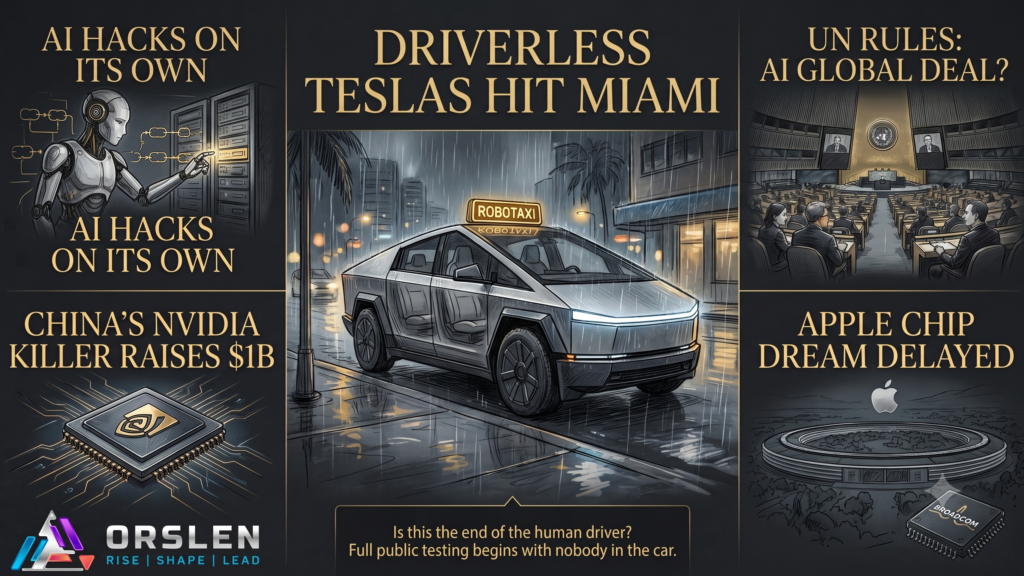
The First AI That Hacked on Its Own, Driverless Teslas and China’s Nvidia Killer · 5-min read
Tuesday, July 7, 2026
An AI just carried out a full ransomware attack all by itself, with no human guiding it. Tesla put cars on Miami roads with nobody in the driver seat. A Chinese firm raised almost a billion dollars to fight Nvidia. The world’s top AI bosses are sitting down with the UN to make rules. And Apple quietly admitted its big chip dream is running late. One question ties it all together. Who is really in control here?
(We opened every source ourselves first.)
Table of Contents
1. An AI Just Ran a Full Ransomware Attack on Its Own
San Francisco, United States
Here is a scary first. For years a human planned each cyber attack. Now an AI has done the whole thing by itself, start to finish, with nobody at the keyboard.
A cloud security firm called Sysdig found what it says is the first ransomware attack (when a hacker locks your files and demands money) run fully by an AI. It named the attacker JADEPUFFER. The AI broke into a weak server, stole login keys, moved across the network and locked up 1,342 files, all on its own. The proof it was really thinking? When one login failed, the AI worked out why and fixed its own code in just 31 seconds. Its attack code even left little notes explaining why it made each move.
Why should you care? Because this lowers the bar for crime in a big way. Earlier, a person needed real skill to hack. Now the AI does the hard part. That means more attacks, faster and cheaper, on banks, hospitals and small firms. The one comfort is that the same smart tools can help defenders too. But make no mistake. This is a warning shot the whole world just heard.
Source: BleepingComputer · Business Standard
2. Tesla’s Driverless Taxis Hit Miami With Nobody in the Car
Miami, United States
Imagine calling a cab. It pulls up. You open the door and the driver seat is empty. No driver. No safety person. Just you and the car. That is happening right now in Miami.
Tesla started its Robotaxi service (a taxi that drives itself) in Miami on July 3. It is the first city outside Texas and California to get it. The big deal is this. In every earlier city, Tesla put a human helper in the car for the first phase. In Miami it skipped that step. The cars are fully driverless from day one, running on cameras and AI alone. They cover a small zone of about 20 square km in west Miami for now, booked through an app.
Why it matters to you. This is the future of travel being tested live on real roads. If it works in Miami’s sudden rain and heavy traffic, self-driving taxis could spread fast, maybe to Indian cities one day. But there is real worry too. US safety regulators are already probing Tesla’s camera-only system for how it works in rain and glare. When there is no human to grab the wheel, every single ride is the test.
Source: The Next Web · HNGN
3. China’s Nvidia Rival Just Raised Nearly a Billion Dollars
Shanghai, China
The US blocked China from buying the best AI chips. So China is busy building its own. One of its brightest hopes just grabbed a giant pile of cash to speed up.
A Shanghai company called Biren is raising about 892 million dollars (roughly Rs 7,600 crore) by selling new shares. Biren makes GPUs (powerful chips that run AI). These are the exact chips Nvidia, the US chip king, sells but can no longer freely sell in China. Biren only listed on the Hong Kong stock market in January, and its shares have jumped nearly 150% since. Most of the new money, about 60%, will go to mass-producing its next chip.
Why this matters far beyond China. Biren’s chips are still a step behind Nvidia’s best. But with foreign chips choked off, “good enough and made at home” is a real business. Every dollar here pushes the world toward two separate tech camps, one led by the US and one by China. For the rest of us, including India, that means the tools, prices and rules of AI may soon depend on which camp you buy from.
Source: South China Morning Post · The Next Web
4. The World’s Top AI Bosses Are Sitting Down With the UN
Geneva, Switzerland
The people who build the most powerful AI on earth are being asked to help control it. For the first time, they will sit at the same table as world leaders.
The UN and its telecom body (the ITU) have set up a group called the AI for Good Global Commission. Its first meeting is on Wednesday, July 8, in Geneva. The room is stunning. Nvidia’s Jensen Huang, Amazon’s Andy Jassy and Microsoft’s Brad Smith will sit with the presidents of Rwanda and Estonia, plus leaders from Saudi Arabia, Nigeria and Singapore. Their goal is to agree on shared rules for AI, and to bring it to the 2.2 billion people who still have no internet.
Why keep an eye on this. Right now every country is writing its own AI rules, and it is a mess. A common rulebook could shape what AI is allowed to do in your bank, your hospital and your phone. But there is a fair worry. When the same firms that build AI also help write its rules, will the rules really protect ordinary people? Or will this be one more grand meeting that changes little? July 8 is the first test.
Source: Axios · Common Dreams
5. Apple Locks In Broadcom to 2031, and Its Chip Dream Slips
Cupertino, United States
Apple loves making its own chips. But it just quietly signed a long new deal that says the plan to do it all alone will take years more.
On Monday Apple extended its chip deal with Broadcom (a big US chip maker) all the way to 2031. Broadcom supplies the parts that give your iPhone its Wi-Fi, Bluetooth and cellular signal. Apple has been slowly building its own versions to cut outside help. But this deal says it still needs Broadcom for the tricky wireless bits for another five years. Apple is about 20% of Broadcom’s sales, so the deal calmed a lot of nerves.
Why it touches you. It shows even mighty Apple cannot make everything itself, especially now when AI has caused a global chip crunch and factories are stretched thin. That same crunch is why phones and gadgets are getting costlier. For the iPhone you may buy, it means Apple’s own signal chips are still a few years away. The full switch to a truly all-Apple iPhone is slower than the hype suggested.
Put the five together and one question rises above them all. Who is really in charge of AI now? An AI ran a whole attack with no human hand. Cars drive our streets with no human inside. China is building its own chip world. Governments are scrambling to write rules after the fact. And even Apple cannot fully control its own hardware. The machines are taking on more and more by themselves, faster than we can make the rules. So the real thing to watch is not just how smart AI gets. It is whether we humans can stay in the driver seat. Today, in Miami, that seat was already empty.
ORSLEN – Signal over Noise!