OpenAI’s Wildest Week: A Historic Launch, Then Apple Attacks · 5-min read
Saturday, July 11, 2026
On Thursday, OpenAI released the most powerful AI it has ever built. On Friday, Apple dragged it to court. In the same 48 hours, Europe ruled that your Instagram scroll is designed to trap you, a Korean chip maker pulled off the biggest Wall Street debut ever by a foreign company and researchers found that the free VPN protecting your phone may be spying on you instead. One question ties it all together: in the AI age, who can you actually trust? (We opened every source ourselves first.)
Table of Contents
1. Apple Sues OpenAI for Stealing Its Secrets
San Francisco, USA
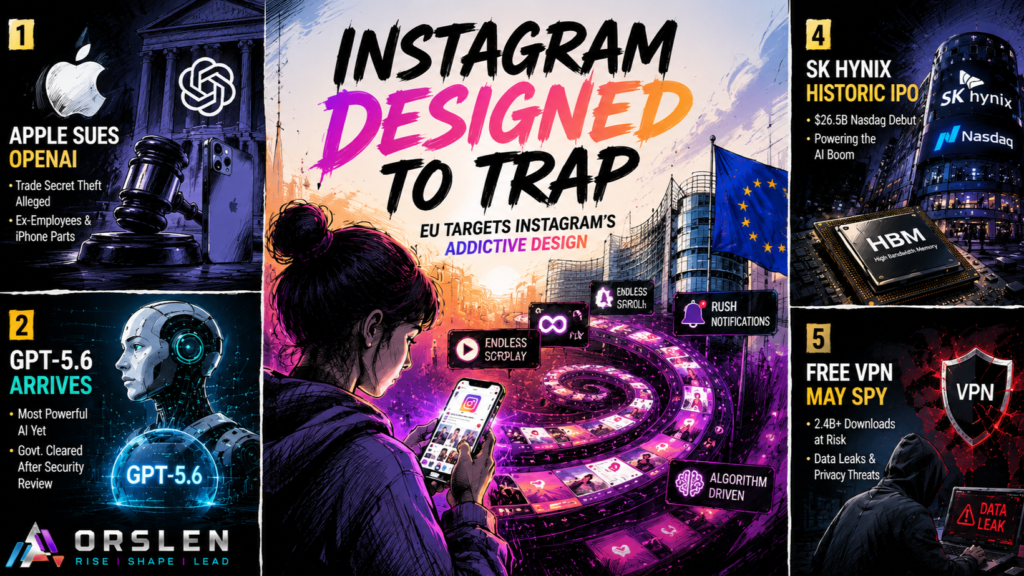
In 2024, Apple and OpenAI shook hands and put ChatGPT inside the iPhone. On Friday, Apple sued OpenAI in a US federal court. The charge is serious: trade secret theft (stealing a company’s private technical know-how). Apple says over 400 of its former employees now work at OpenAI, and some carried Apple’s secrets with them. The most shocking claim is about OpenAI’s hardware chief Tang Tan, himself an ex-Apple veteran. Apple says he told job candidates who still worked at Apple to bring actual iPhone parts to their interviews for show and tell. Another ex-engineer allegedly kept his Apple laptop and downloaded dozens of confidential files after leaving. OpenAI denies everything and says it has no interest in anyone’s secrets. Why should you care? OpenAI is building its first gadget, expected this year, and preparing a giant IPO (selling shares to the public). This case could shake both. It could even decide whether ChatGPT stays on your iPhone at all.
Source: CNBC · TechCrunch
2. OpenAI Unleashes GPT-5.6, Its Most Powerful AI Yet
San Francisco, USA
Just one day before the lawsuit hit, OpenAI had its biggest moment of the year. On Thursday, it released the GPT-5.6 family to the public: Sol, the flagship for the hardest work, Terra for everyday tasks and Luna, the fast and cheap one. Here is the twist. The models were ready two weeks ago, but the US government asked to review them first because of their powerful hacking-related skills. Only after extra testing by the Commerce Department did the wide release happen. That is a first in AI history: a frontier model effectively waiting for Washington’s nod. The part that touches your wallet is pricing. Terra matches the older GPT-5.5 at half the cost, and Luna starts at just 1 dollar (about Rs 87) per million tokens (the small text pieces AI reads and writes). Cheaper AI means cheaper apps, tools and services built on it, including the ones Indian startups ship to you. One caution: the performance claims come from OpenAI itself, so let independent testers have their say.
3. Europe Says Instagram Is Built to Trap You
Brussels, Belgium
Ever opened Instagram for two minutes and looked up an hour later? The European Union says that is not your weakness. It is the design. On Friday, the European Commission ruled in a preliminary finding that Meta’s Instagram and Facebook break the EU’s Digital Services Act (Europe’s big law for online platforms). The problem features are the ones you know well: infinite scroll, videos that autoplay, push notifications and a feed that learns exactly what keeps you hooked. Regulators say these push your brain into autopilot mode and Meta never properly checked what that does to people’s mental health, especially children. The EU wants autoplay and infinite scroll switched off by default, plus real screen-time breaks. Meta disagrees and will respond. If the finding is confirmed, the fine can reach 6 percent of Meta’s global revenue, about 12 billion dollars (roughly Rs 1 lakh crore). If Meta changes Instagram for Europe, the same design could reach your phone in India too.
Source: European Commission · CNBC
4. SK Hynix Makes Wall Street History
Seoul, South Korea
Remember the Korean chip giant that announced a giant Wall Street plan last month? The bet just landed. SK Hynix started trading on the Nasdaq on Friday and raised 26.5 billion dollars (about Rs 2.3 lakh crore). That makes it the largest US share sale ever by a foreign company, bigger than Alibaba’s famous 2014 debut. The stock opened at 170 dollars and closed the day up 13 percent. Why so much love? SK Hynix makes HBM (special high-speed memory chips, stacked in layers, that AI systems need) and controls over half that market. Nvidia, the world’s most valuable company, is its biggest customer. Demand is so wild that the chairman says even doubling capacity is not enough. Here is where it touches you. This same memory shortage is why phone and laptop prices have been climbing all year, including in India. The money raised will build new factories, but relief for your wallet is still years away.
5. Your Free VPN May Be Spying on You
New Delhi, India and Ann Arbor, USA
You installed a free VPN (an app that hides your internet activity) to stay private. New research says many of these apps do the exact opposite. Researchers from the University of Michigan, the University of New Mexico and IIT Delhi tested 281 popular free VPN apps from the Google Play Store. The apps with at least one problem have been downloaded more than 2.4 billion times. The failures are basic. 29 apps leaked user traffic outside the protected tunnel, including the website names you visit. 61 apps sent data as plain text that anyone on the same WiFi could read. 76 apps quietly sent your device ID to third parties for tracking. Five apps were so weak that an attacker on your network could redirect your entire connection to a server they control. The lesson is simple and urgent. If a VPN is free, ask what it is selling. Check the apps on your phone today, and if you truly need privacy, a trusted paid service beats a free stranger.
Source: The Hacker News · Digital Trends
The Big Picture
Look closely and all five stories are about one thing: trust. Apple no longer trusts its AI partner. The US government wanted to test OpenAI’s model before you could touch it. Europe does not trust Instagram with your attention. Wall Street placed record trust in one Korean chip maker. And the free VPN you trusted may have been the leak all along. In the AI age, trust is the real currency, and this week showed how fast it can be earned, priced or broken.
ORSLEN – Signal over Noise!