
A Government Just Switched Off the World’s Smartest AI Overnight, And 9 More Stories You Need Today · 10-min read
One government order just switched off the planet’s most powerful AI overnight, and almost nobody saw it coming. On the very same weekend, Elon Musk crossed a line no human ever has and became the world’s first trillionaire. India’s brightest startups landed a stage in France, Dubai rebuilt its government around AI, and World Cup stadiums quietly turned into surveillance labs. A new hydrogen engine, a sneaky Chrome extension scam, and a trick that can hijack your AI coding assistant round out the list. The question running through all of it: who actually controls the AI, the money and the tech tools your work depends on, and what happens the day someone else decides to flip the switch. (We opened every source ourselves first.)
Table of Contents
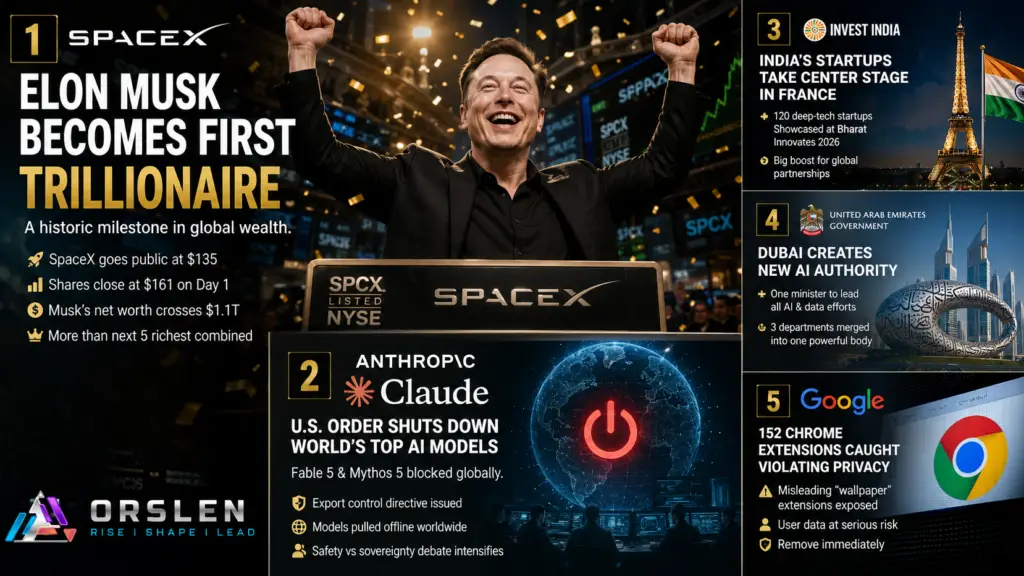
1. America Just Switched Off the World’s Most Powerful AI, And Nobody Asked Permission
Washington DC, USA.
Imagine your favourite AI assistant just stops working one morning, not because of a bug, but because a government told the company to turn it off. That is what happened late on Friday. The US government sent AI company Anthropic an order using something called an export control directive (a rule normally used to stop sensitive technology leaving the country), telling it to block its two most powerful models, called Fable 5 and Mythos 5, for anyone who is not a US citizen, even Anthropic’s own staff working abroad. Anthropic said it has no quick way to separate US users from everyone else in real time, so it switched both models off for the entire world. Every other Claude model still works fine. The reason given: US officials believe someone found a way to jailbreak (trick the AI into ignoring its safety rules) Fable 5. Anthropic disagrees about how serious this really is. British MP Tom Tugendhat summed up the mood, saying sovereignty is now about code, not cannons. For anyone in India whose work leans on an overseas AI tool, this is the clearest sign yet that access can vanish overnight, with zero say from the people who actually use it.
Source: Euronews · Cyber Security News
2. World Record: Elon Musk Just Became the First Trillionaire, On Paper
New York, USA.
For years people argued about whether any single human could ever be worth one trillion dollars. On June 12, it happened. Elon Musk’s rocket company SpaceX listed on the US stock market (an IPO, which is when a private company sells shares to the public for the first time) under the ticker SPCX. The shares were priced at 135 dollars, opened at 150, and closed their first day near 161. That jump pushed the value of Musk’s stake in SpaceX, plus his Tesla shares and other holdings, to roughly 1.1 trillion dollars, making him the first trillionaire in history. To put that in plain terms: that is more than the next five richest people on earth combined, and bigger than the entire yearly economic output of countries like Sweden or Ireland. One important catch though, this is wealth “on paper.” It is mostly the value of shares, not cash in a bank, so if SpaceX stock falls, he could slip back under the trillion mark just as fast. Still, it is a milestone that has reopened a loud global debate about whether one person should ever hold this much wealth.
3. India’s Startups Just Got the Red Carpet in France, And It’s a Big Deal
Nice, France.
While the Fable 5 drama was unfolding, something much more positive was happening on the French Riviera. Prime Minister Modi and French President Macron opened Bharat Innovates 2026, a three-day showcase that brought 120 Indian deep-tech startups and 15 top Indian colleges (think IITs and similar institutes) to Nice for the first time ever, on a stage usually reserved for European tech. These startups work in areas like semiconductors (computer chips), AI, quantum computing and space tech. Macron called India a major innovation nation and pointed out that France has created more AI jobs than any other EU country, with nearly 20,000 new AI roles in Paris alone since 2023. For Indian engineers and founders, this is exactly the kind of event that turns into real funding, partnerships and even job offers in Europe. Modi and Macron then headed off for bilateral talks before the G7 summit begins in Evian on Monday, where AI and trade will be high on the agenda.
Source: Euronews
4. Dubai Just Put One Minister in Charge of All of Its AI
Dubai, UAE.
On the same day, the UAE quietly made one of its biggest government shake-ups in years. Sheikh Mohammed bin Rashid Al Maktoum, the ruler of Dubai and the country’s prime minister, approved a brand new Federal Authority for Artificial Intelligence and Data. This single body now takes over three separate departments: the old AI office, the digital government team, and the national data office. It reports straight to the Cabinet and will be run by Omar Sultan Al Olama, the country’s AI minister. The goal, in his words, is a government that runs on data and what officials call agentic AI (AI systems that can take actions and make decisions on their own, not just answer questions). Think faster passport renewals, smarter traffic systems, and government apps that actually talk to each other instead of asking you for the same documents five times. It is also a strong signal to the rest of the world: the UAE wants to be known as a country where AI runs the government, not just helps it.
Source: Gulf News
5. 152 Free Chrome “Wallpaper” Extensions Were Lying About Your Privacy
California, USA.
Here’s one to check on your own laptop tonight. Security researchers at a firm called Socket found a network of 152 Chrome extensions, mostly “live wallpaper” or “new tab” add-ons with themes like anime, football and cars, that had been installed about 105,000 times combined. Every single one of them told Google’s Chrome Web Store, in writing, that they do not collect any user data. But the extensions’ own privacy policies said the exact opposite: they log your IP address, your internet provider, your device details, your clicks, and your browsing habits, then hand that data to Google’s ad network and other advertisers. Some of them even faked traffic to make it look like people found their websites through a normal Google search, which tricks advertisers into thinking those sites are more popular and trustworthy than they really are. If you ever installed a wallpaper or new-tab extension just for fun, this is your reminder to open Chrome’s extension list and check what is actually running quietly in the background.
Source: Cyber Security News

6. World Cup Stadiums Are Quietly Testing Robot Dogs and Face Scanners on You
Dallas and Boston, USA.
While millions of fans cheer at this month’s FIFA World Cup across 16 stadiums in the US, Canada and Mexico, a quieter story is playing out behind the scenes. Stadiums like Gillette in Boston, Hard Rock in Miami and Mercedes-Benz in Atlanta are now using AI-powered facial recognition so registered fans can walk in and pay for snacks just by showing their face, no ticket or card needed. In Dallas and New Jersey, four robot dogs fitted with cameras are patrolling key areas. Behind all of this, the US government has put about Rs 3,000 crore (around 365 million dollars) into this security setup, much of it for drone and anti-drone technology. Privacy groups like the ACLU and the Electronic Frontier Foundation are warning that none of this is temporary. After Qatar’s 2022 World Cup, over 15,000 cameras stayed switched on long after the tournament ended. The worry is simple: the new tech you see at the stadium today might be watching your city, permanently, from tomorrow.
Source: Gadget Review
7. The UK and Japan Just Signed a Tech Pact, And It’s Really About Chips and Jets
London, UK.
British Prime Minister Keir Starmer hosted Japanese Prime Minister Sanae Takaichi at Downing Street, and the two countries signed something called the UK-Japan Frontier Technology Partnership, along with a joint Economic Security Declaration. On paper this sounds like diplomatic small talk. In practice it means the two countries will work more closely on AI, quantum computing, drones and advanced manufacturing, areas that increasingly double up as both civilian tech and defence tech. The two leaders also confirmed they are pushing ahead with a joint next-generation fighter jet programme alongside Italy. The bigger backdrop here is the ongoing tension in the Middle East, which both countries discussed as a factor in energy and supply chain security. For anyone working in tech, the lesson is the same one showing up again and again this year: chips, AI models and advanced manufacturing are no longer just business topics, they are treated as national security topics too.
Source: GOV.UK
8. 890 Companies From 23 Countries Just Showed Off China’s Next Chip Moves
Changchun, China.
In northeast China’s Jilin province, a city most people outside China have never heard of just hosted one of the country’s biggest tech expos of the year. Changchun calls itself the birthplace of China’s optoelectronics industry (optoelectronics is the tech behind things like camera sensors, lasers and fibre-optic internet). This year’s International Optoelectronics Expo brought together more than 890 companies and institutions from 23 countries, with over 100 new Chinese tech breakthroughs on display across semiconductors, ultra-precision optics and even commercial aerospace. One example that stood out: a company showing off new imaging spectrometer chips (sensors that capture far more detail and colour than a normal camera sensor) that are already built into the cameras of a major Chinese smartphone brand, making photos look more natural. With chip supply chains under constant political pressure worldwide, expos like this show China continuing to push hard on the optics and sensor side of the chip race, an area that gets far less attention than AI chips but matters just as much for phones, cars and cameras.
Source: CGTN
9. A 13,000-Horsepower Engine Just Ran on Pure Hydrogen, and Lit Up Spain’s Power Grid
Bermeo, Spain.
On the Basque coast of northern Spain, something genuinely new happened in the energy world. Finnish company Wartsila successfully ran a giant piston engine, the Wartsila 31H2, on 100 percent pure hydrogen and fed the electricity it produced straight into Spain’s national power grid. This is being called a world first for large-scale power generation of this kind. Unlike a hydrogen fuel cell (which produces electricity through a chemical reaction with no moving parts), this is old school combustion, the engine burns hydrogen the way a diesel engine burns diesel, just with zero carbon emissions. The big problem this could help solve is what happens when the sun isn’t shining and the wind isn’t blowing: these hydrogen engines can switch on quickly to fill that gap without burning fossil fuels. Wartsila says several of these units could eventually be combined into full power plants. The catch, as experts admit, is that the world still needs a lot more investment in producing, storing and moving hydrogen before any of this becomes common.
Source: Euronews
10. IBM let an AI Loose on Quantum Computers, and It Found 465 New Tricks
New York, USA.
IBM’s research team has been working on a problem that sounds simple but isn’t. Quantum computers are powerful, but the basic units they run on, called qubits, are extremely fragile and prone to errors. To fix this, scientists use what are called error correction codes, mathematical recipes that use several physical qubits to protect one reliable logical qubit. The trouble is there are billions of possible recipes, and testing them by hand takes forever. So IBM built a tool called OpenEvolve, which uses AI language models in a loop. The AI suggests a recipe, a faster check filters out the weak ones, and the best ones go through a slower, more thorough test. In just one run, this found 465 new error correction codes. One needs only 72 physical qubits to work, and another can protect 50 logical qubits at once, more than three times the previous record of 16. IBM has made the whole tool open source for other researchers to use, a small but real step toward the reliable quantum computers companies have been promising for years.
Source: IBM Research
BONUS: AI SHIELD – One Fake Error Message Can Trick Your AI Coding Assistant Into Leaking Your Passwords

Online, Worldwide.
If your company uses AI coding assistants like Claude Code or Cursor, this one is worth reading twice. Security firm Tenet found a new attack they call agentjacking. Many websites use a tool called Sentry to track errors, and Sentry hands out a public key (called a DSN) so error reports can be sent in from anywhere. Tenet found this public key sitting openly in the website code of over 2,300 companies, including some of the world’s most visited sites. An attacker can use that key to send a fake error report that looks completely normal. When a developer later asks their AI coding assistant to fix the latest Sentry errors, the AI reads this fake report as a trusted instruction and runs a command planted by the attacker, one that quietly checks for cloud passwords and config files, then sends the details back to the attacker. In tests across more than 100 real companies on six continents, this worked about 85 percent of the time. Sentry has added a partial fix but says the real solution has to come from how AI tools handle outside data. If your team uses AI coding agents, this is worth raising with your security folks this week.
Source: Cyber Security News
From Nice to Dubai to Dallas to Bermeo, the answer in 2026 increasingly depends on which government, which company, and which country you happen to be standing in.
ORSLEN – Signal over Noise!