
OpenAI’s Own Chip, a $29 Billion Bet and Robots by the Thousand · 5-min read
Thursday, June 25, 2026
Today a top AI lab stopped buying other people’s chips and made its own. A Korean chip giant asked Wall Street for one of the biggest cheques in history. A big bank said China will ship far more robots than anyone guessed. Two old rivals and one Linux maker joined hands to fight hackers who now move in minutes. And a phone-chip leader spent billions on software it does not even make. One question ties all five together: who really controls the machines behind your screen? (We opened every source ourselves first.)
Table of Contents
1. OpenAI just made its first chip and aimed it at Nvidia
San Francisco, USA
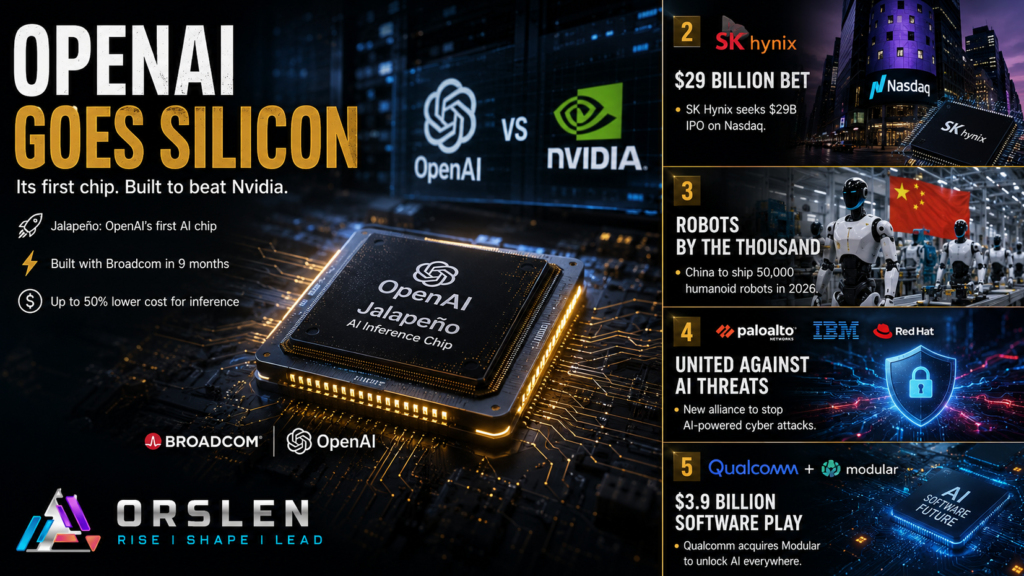
OpenAI built its own AI chip for the first time. It is called Jalapeno. (A chip is the tiny brain inside a computer that does all the maths.) Until now OpenAI mostly rented chips from Nvidia, the company that rules this market. Today it showed a chip it designed itself with Broadcom, a big chip partner. OpenAI says it finished the design in just nine months. That is very fast for this kind of work. The chip is built for one job called inference. (Inference is the moment the AI actually answers you, like when a chatbot replies.) Broadcom’s boss said early tests show it runs that job for about half the cost of today’s top chips. Cheaper chips can later mean cheaper AI for you. It can also loosen Nvidia’s tight grip on the whole field. The first ones go live by the end of 2026. If it works, the apps you use every day get cheaper to run and one company stops holding all the power.
2. SK Hynix asked Wall Street for $29 billion and it could hit your phone bill
Seoul, South Korea
SK Hynix is the world’s top maker of a special memory chip used in AI. (Memory chips hold data so a computer can grab it fast.) Today the Korean firm asked to sell its shares on the US market called Nasdaq. It wants to raise up to about $29 billion. In rupees that is close to ₹2.4 lakh crore. That makes it one of the biggest share sales the world has ever seen. It is even bigger than the famous Saudi Aramco sale of 2019. SK Hynix will use the money to build new factories and buy very costly machines. Here is the part that touches your pocket. The world does not have enough of these memory chips right now. AI data centres are eating them up. That shortage is already pushing up the price of phones and laptops. So the next time a new phone costs more than you expected, this is one big reason behind it. Trading is set to start around July 10.
3. China is about to flood its factories with robots
Shanghai, China
China is getting ready to put human-shaped robots to work at a huge scale. This week the big bank Morgan Stanley doubled its guess for how many China will ship in 2026. The new number is 50,000 robots. At the start of the year the same bank guessed only 14,000. These are humanoid robots. (Humanoid means shaped like a person, with two arms and two legs.) They are leaving the show stage and starting real work in factories, shops and warehouses. One Chinese power company alone ordered robots worth about $1 billion, near ₹8,500 crore. Car maker Xpeng plans to build them in big numbers by the end of this year. Morgan Stanley thinks this market will grow from about $2 billion now to $15 billion by 2030. For workers everywhere this is the real question of the decade. As machines learn to lift, sort and carry, which jobs stay human? China is moving faster on this than any other country.
Source: CNBC · South China Morning Post
4. AI now finds security holes in minutes so three giants joined to fight back
Santa Clara, USA
Three tech giants joined forces today to fight a scary new problem. AI is now finding weak spots in software faster than humans can fix them. (A weak spot, or bug, is a hole a hacker can sneak through.) Palo Alto Networks, IBM and Red Hat said they will work as one team. Their plan uses two shields. One blocks the attack on the network the same day a hole is found. The other quietly fixes the software underneath. The Palo Alto boss put it sharply. He said AI has cut the gap between finding a hole and attacking it from weeks down to minutes. Old-style fixing simply cannot keep up. This matters for you because the apps on your office laptop and your bank run on this same kind of software. When a hole opens, your data sits in that gap. A faster shield means your private info spends less time exposed. It is a quiet story but it touches every person who uses the internet.
Source: IBM · Palo Alto Networks
5. Qualcomm makes phone chips so why did it just buy a software firm for $3.9 billion?
San Diego, USA
Qualcomm is famous for the chips inside your phone. Today it spent about $3.9 billion, near ₹33,000 crore, to buy a software company called Modular. Notice the word software. Qualcomm makes hardware, so why buy code? Because in AI, the software that runs a chip matters as much as the chip itself. Modular built tools that let one AI program run smoothly on many kinds of chips, not just one brand. That means a company is not locked to a single chip maker. Qualcomm wants this to push deeper into AI data centres and lean less on phones alone. The deal is all in shares, not cash. It also brings in Modular’s small but sharp team, led by a well-known engineer named Chris Lattner. For you, this is a sign of where the fight is going. The next AI race is not only about who makes the fastest chip. It is also about who makes that chip easy to use. The deal should close later in 2026.
Look at all five together and one picture appears. The whole tech world is racing to own the machines under your screen. OpenAI wants its own chips. SK Hynix wants the cash to make more memory. China wants robots in every factory. Qualcomm wants the software that ties chips together. And the security giants want to guard all of it. On top, the apps feel free and simple. But underneath, a giant and costly fight is on for chips, memory, robots and code. Whoever wins that fight will shape what your phone, your job and your money look like for years.
ORSLEN – Signal over Noise!